Infrared Blocking in Window Tints: Top Technologies Compared
Infrared-blocking window tints reduce heat, protect interiors, and improve energy efficiency by reflecting or absorbing infrared (IR) radiation. Modern options include dyed, metalized, carbon, nano-ceramic, graphene-infused, and dedicated IR films. Nano-ceramic and graphene-infused tints lead in performance, blocking over 90% of IR while maintaining visibility and signal compatibility. These films also reject harmful UV rays, keeping your car cooler and safeguarding interiors from fading or cracking. Key considerations include IR rejection rates, durability, and compatibility with electronic systems.
Quick Overview:
Nano-Ceramic Tints: Block 90–98% IR, non-metallic, last 10–15 years.
Graphene-Infused Tints: Block 91–94% IR, superior heat dissipation, highly durable.
Dedicated IR Films: Over 99% IR rejection, nearly clear, ideal for hot climates.
For the best results, professional installation is recommended to ensure precision and longevity.
Engineers Test the Best Car Window Tints
sbb-itb-74b4b25
Nano-Ceramic Window Tints
Nano-ceramic window tints are at the forefront of infrared-blocking technology, offering an effective way to reduce interior heat. These tints use nano-scale ceramic particles that allow visible light to pass through while deflecting infrared and ultraviolet rays. Because these particles are smaller than the wavelength of visible light, they don’t scatter light or create the haze often associated with older carbon-based films.
How Nano-Ceramic Technology Works
The technology behind nano-ceramic tints is all about precision. These microscopic particles filter specific wavelengths, letting in visible light while reflecting and scattering infrared and UV rays. This can lower your car’s cabin temperature by 20–25°F. Unlike traditional dyed films that absorb heat and then radiate it back into the cabin, nano-ceramic tints work by reflecting and scattering heat away from the vehicle.
"Ceramic is one of the earth’s most timeless insulators and heat-resistant materials. Take those properties and bring them down to a size where they can impact and absorb a spectrum of non-visible light associated with heat, and you greatly reduce the thermal load inside your vehicle." – Steven Schroer, Sales & Marketing Manager for the Americas, Solar Gard
Another advantage is their non-metallic design, which avoids signal interference, ensuring smooth operation of GPS, 5G, Bluetooth, satellite radio, and toll transponders. These benefits not only improve functionality but also contribute to longer-lasting tints and better interior protection.
Benefits of Nano-Ceramic Tints
Nano-ceramic tints bring a range of impressive benefits. They block up to 98% of infrared radiation and over 99% of harmful UV rays, which not only keeps the cabin cooler but also protects your dashboard, seats, and other interior surfaces from fading or cracking. Unlike dyed tints, these films resist oxidation and discoloration, often lasting 10 to 15 years with proper care. This advanced heat control also reduces the strain on your vehicle’s air conditioning system, leading to improved energy efficiency.
When evaluating different brands, focus on the Infrared Energy Rejection (IRER) rating instead of just the Infrared Rejection (IRR) percentage. IRER gives a clearer picture of the actual heat reduction you’ll experience by factoring in both reflected and absorbed energy. For maintenance, stick to ammonia-free cleaners and use a soft microfiber cloth to preserve the adhesive and prevent scratches.
Graphene-Infused Window Tints
Graphene-infused window tints represent a step forward from nano-ceramic technology. By combining graphene with ceramic nanoparticles, these films offer advanced heat control capabilities. What makes graphene stand out is its extraordinary thermal conductivity – twice that of diamond. This unique property allows graphene to not only block heat but also disperse it efficiently, setting it apart from traditional materials.
What Graphene-Infused Tint Is
Unlike standard nano-ceramic films that simply reflect and absorb infrared radiation, graphene-infused tints take it a step further by actively conducting thermal energy. This results in a cooler interior environment. These tints blend graphene with non-metallic nanoparticles such as antimony tin oxide (ATO) and tungsten, which act as primary infrared absorbers.
"Graphene… dramatically accelerates the rate of heat dissipation. It has excellent mechanical, physical and chemical properties and is twice as thermally conductive than diamond." – STEK USA
In December 2020, STEK launched the NEXseries, a graphene-infused nano-ceramic window film. This product boasts a 94.59% infrared rejection rate and a 64% Total Solar Energy Rejection (TSER), showcasing its superior performance compared to traditional films. It also blocks 99.9% of UV rays, earning a recommendation from the Skin Cancer Foundation. Additionally, its non-metallic composition ensures it won’t interfere with GPS, cell phone signals, or radio reception.
Benefits of Graphene-Infused Films
Graphene-infused films bring several advantages, particularly in thermal management. They achieve infrared rejection rates between 91% and 93%, depending on the shade, and limit heat transfer to as low as 1.8°C. By blocking 99% to 99.9% of UV-A, UV-B, and UV-C rays, these films protect both your skin and your vehicle’s interior from harmful sun exposure.
The inclusion of graphene also improves the film’s durability, offering enhanced scratch resistance and structural integrity while maintaining excellent optical clarity with minimal haze. These films can endure temperatures up to 176°F without peeling or bubbling, making them well-suited for extreme weather conditions. For electric vehicle owners, the superior heat rejection reduces the strain on climate control systems, helping to conserve battery life. Many premium graphene-infused tints come with a limited lifetime warranty, covering issues like fading, delamination, bubbling, and cracking.
Dedicated Infrared-Blocking Films
Graphene-infused films are great at dispersing heat, but dedicated infrared (IR) films take a different approach. These films are specifically designed to block the infrared spectrum, which is responsible for about 53% of solar heat, while maintaining near-clear visibility. Unlike darker tints that rely on shade to absorb heat, IR films use spectral selectivity to reject heat without affecting your view.
How These Films Work
Dedicated IR films are built with multi-layer designs that reflect and absorb infrared radiation. Advanced versions utilize Magnetron-sputtering technology, a process that deposits ultra-thin layers of materials like titanium or silver in a vacuum environment. The result? Films that can block over 99% of infrared radiation while remaining nearly invisible. They also reflect up to 80% of incoming solar heat. Plus, they won’t interfere with GPS, cell signals, or driver-assistance systems.
"With this latest technology in tinting, you can mute all the bright lights without darkening the view with multi-layer optical films." – Carlikefilm
When to Use Infrared-Blocking Films
These films shine in specific scenarios. If you live in hot regions like Arizona, Florida, or Texas and need clear visibility for nighttime driving, IR films are a smart choice. They provide excellent heat rejection in lighter shades – often with 70% or 80% visible light transmission (VLT). They’re also ideal in areas with strict window tinting laws, where darker tints on front windows might not be allowed.
For electric vehicle owners, these films can make a noticeable difference. By reducing HVAC energy consumption by 16% to 18%, they can add 25 to 27 miles of range per charge. In thermal tests, ceramic IR films kept cabin temperatures about 13°F cooler than carbon-based alternatives in identical conditions. Drivers who spend long hours on the road also benefit from protection against UV exposure, as premium IR films block up to 99.9% of harmful UV-A and UV-B rays.
Leading Brands and Product Comparisons
Window Tint Technologies Comparison: IR Rejection, UV Protection, and Pricing
Now that we’ve covered advanced technologies, let’s dive into how leading brands stack up when it comes to infrared blocking performance.
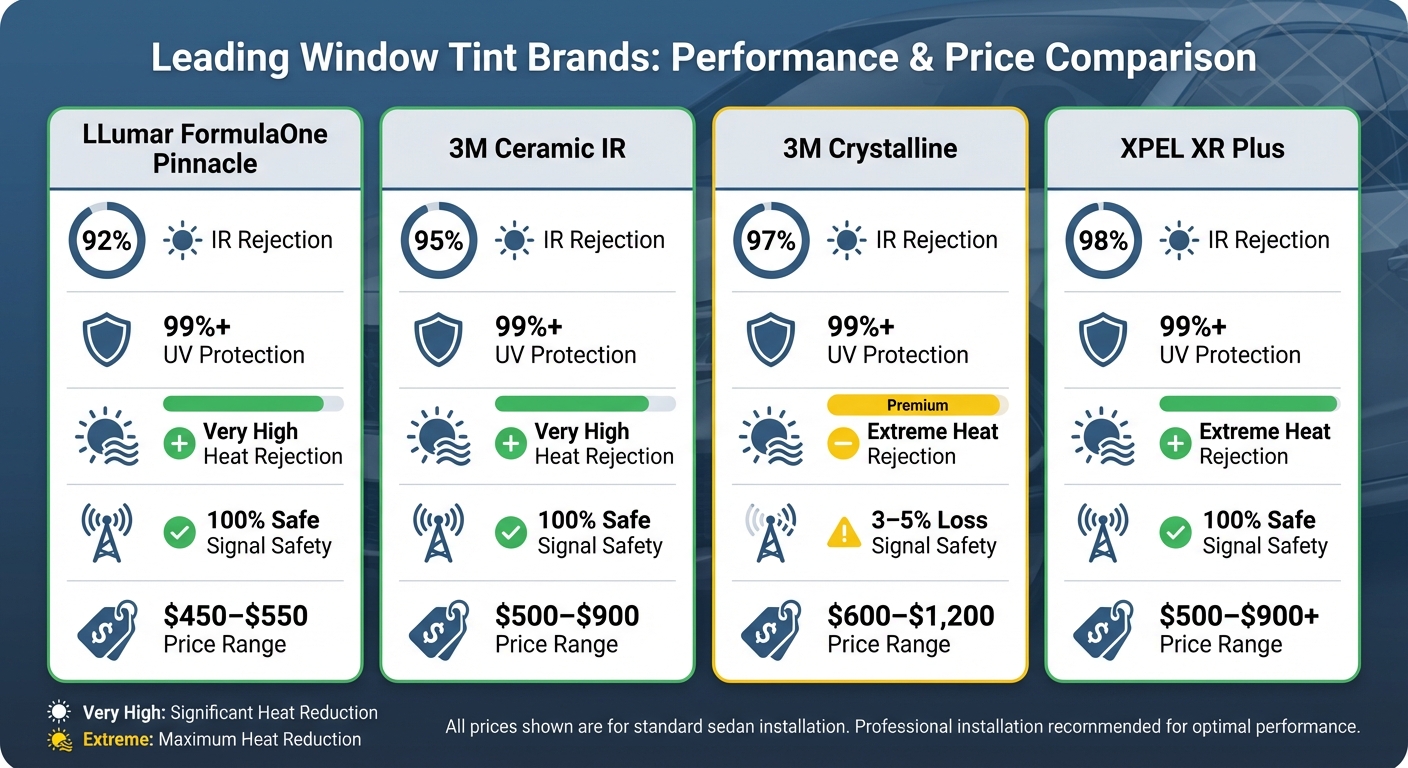
The LLumar FormulaOne Pinnacle series delivers 92% infrared rejection while maintaining excellent optical clarity. It comes with a transferable lifetime warranty, which could boost resale value, and provides over 99% UV protection along with 80–85% glare reduction. For a standard sedan, professional installation typically costs between $450 and $550. If you’re in a high-heat area, LLumar’s IRX line is a great option, blocking 88% of infrared rays and featuring a modern blue tint. Plus, there’s no interference with electronic signals.
3M offers two standout products for infrared blocking. The Ceramic IR series uses nano-ceramic technology to block up to 95% of infrared rays. It’s metal-free, so GPS and cell signals remain unaffected. Installation costs range from $500 to $900.
Then there’s the 3M Crystalline series, which takes performance a step further. With over 200 nanotech layers, it achieves 97% infrared rejection – even in lighter shades – and can reduce interior temperatures by about 15°F. However, this ultra-premium option comes at a higher cost, typically 20% more than the Ceramic IR series, with prices ranging from $600 to $1,200 for full vehicle installation. Keep in mind, though, that it may cause a slight 3–5% signal loss for GPS and cellular devices.
"If the ceramic blocks around 40% of heat, and Crystalline blocks about 60%, you’re paying about three times more for only 20% better performance." – Ben A., OC Tint Shop
Auto Sound & Security combines top-tier infrared-blocking technologies with expert installation services to ensure your window tints perform at their best. Partnering with leading brands like 3M, LLumar, Huper Optik, and SunTek, they deliver premium ceramic and nano-ceramic films that provide excellent heat rejection without interfering with signals. As an authorized dealer, they offer access to the same high-performance films mentioned earlier, giving you peace of mind knowing you’re getting the best in the market.
The installation process is just as crucial as the film itself. Auto Sound & Security uses climate-controlled facilities to prevent dust and airborne particles from contaminating the tint, which helps avoid those annoying bubbles. Their installers rely on advanced software for precision cutting, ensuring a perfect, gap-free fit. This eliminates the risks associated with hand-cutting and ensures the films perform exactly as designed – delivering the heat rejection and infrared-blocking benefits you expect.
"SunTek’s commitment to utilizing cutting-edge materials positions it as possibly the best car window tint brand; that’s why we are happy to partner with them in our installations." – Pro Car Sound & Security
If you’re deciding between options like LLumar IRX (97% infrared rejection) or 3M Ceramic IR (95% infrared rejection), Auto Sound & Security’s team can guide you to the nano-ceramic film that fits your needs – balancing performance and budget for the ultimate driving experience.
Other Services Available
Auto Sound & Security doesn’t just stop at window tinting. They offer a wide range of car modifications and accessories, including:
Alarm and remote start systems (authorized dealer for Viper and Compustar)
Whether you’re pairing infrared-blocking tints with premium audio systems or upgrading your vehicle’s security, Auto Sound & Security has the expertise to bring your vision to life.
Conclusion
Main Points
Nano-ceramic films rely on nanoparticles to selectively reflect and absorb infrared (IR) radiation, effectively blocking up to 90% of IR heat. In comparison, carbon-based films absorb around 50% of IR energy. Ceramic tints can lower cabin temperatures by as much as 45% and keep interiors 20–30°F cooler during peak sunlight. This not only enhances comfort but also improves fuel efficiency in traditional gas-powered vehicles and extends battery range in electric cars. Additionally, premium films block 99% of harmful UV rays, offering protection for both your skin and your vehicle’s interior.
These performance factors are key when deciding on the right tint for your needs. Pay close attention to the Total Solar Energy Rejection (TSER) percentage, which represents the combined blocking of IR, UV, and visible light. For drivers in hot climates like Texas or Florida, ceramic films are often the top recommendation due to their excellent heat-rejection properties.
What to Do Next
To ensure you get the best results, professional installation is essential. Auto Sound & Security provides expert installation in climate-controlled facilities, using precision cutting techniques that guarantee a seamless, gap-free fit. They work with trusted brands to offer high-quality films, whether you’re looking for the advanced heat rejection of ceramic tints or the balanced performance of carbon-based options.
Schedule a consultation today at Auto Sound & Security and explore how professional-grade infrared-blocking tints can enhance your driving experience.
FAQs
What’s the difference between IRR, IRER, and TSER?
When it comes to window tints, understanding how they handle heat and infrared energy is key. Here’s a breakdown of three important metrics:
IRR (Infrared Rejection): This measures the percentage of infrared energy blocked within a specific range of wavelengths, typically 900–1,000 nm. It’s a focused look at how well the tint handles a narrow band of infrared heat.
IRER (Infrared Energy Rejection): A broader metric, IRER calculates the percentage of total infrared energy rejected across a wider range, from 780–2,500 nm. This gives a more complete picture of infrared rejection.
TSER (Total Solar Energy Rejected): TSER goes beyond just infrared. It represents the overall percentage of solar energy blocked, including ultraviolet (UV), visible light, and infrared energy. This makes it the most all-encompassing measure of how effectively a tint reduces heat.
Each of these metrics highlights a different aspect of performance, helping you choose the right window tint for your needs.
Which tint blocks heat best without making windows darker?
High-quality ceramic window tints are a top choice for keeping heat at bay without making your windows too dark. These tints work by reflecting and absorbing infrared radiation, which is the primary culprit behind heat. What’s great is that they maintain a lighter, more transparent look while still delivering impressive results. Ceramic tints can block over 80% of infrared heat and nearly all UV rays, providing outstanding heat reduction without sacrificing visibility or relying on darker shades.
Will infrared-blocking tint affect GPS, 5G, or Bluetooth?
When it comes to infrared-blocking tints, the material matters. Non-metallic options, like ceramic or carbon-based tints, are great choices because they don’t interfere with signals like GPS, 5G, or Bluetooth. On the other hand, metallic tints can disrupt these signals, leading to reduced accuracy.
If maintaining strong signal performance is a priority, sticking to non-metallic tints is the smarter choice. They offer effective infrared blocking without compromising connectivity.
We use cookies to ensure that we give you the best experience on our website. If you continue to use this site we will assume that you are happy with it.