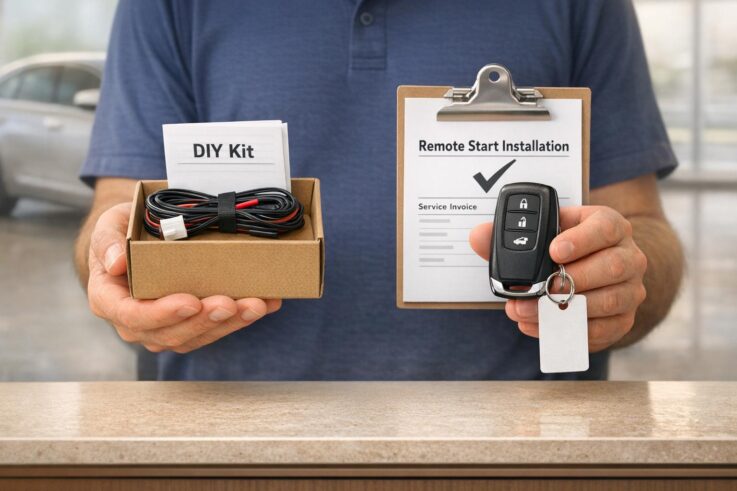
DIY vs Professional Remote Start Installation Costs
When deciding between DIY and professional installation for a remote start system, the choice often comes down to cost, skill level, and risk tolerance. Here’s the quick breakdown:
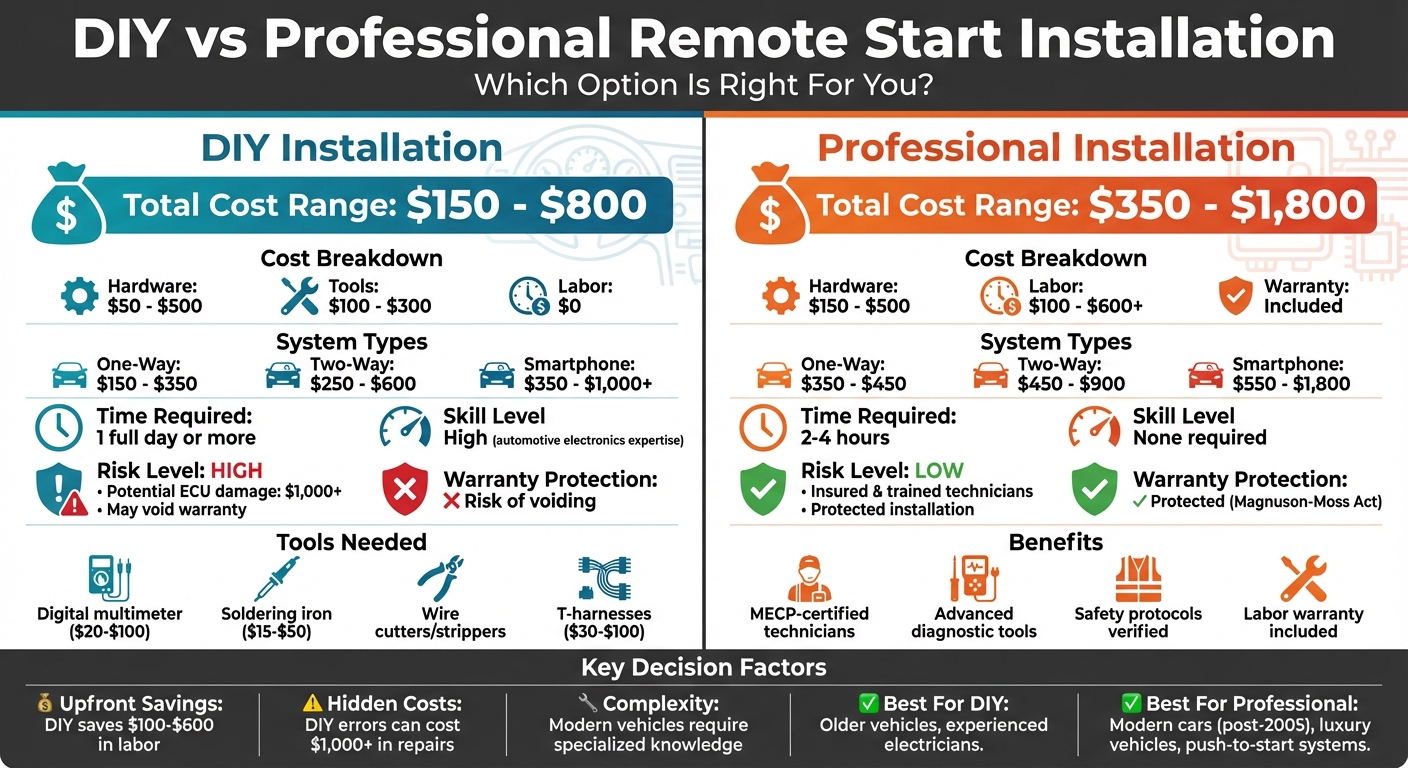
DIY Installation: Costs range from $150 to $800, including hardware and tools. While you save on labor, it requires technical expertise in automotive electronics, wiring, and bypass modules. Mistakes can lead to costly repairs, such as ECU damage, which may cost $1,000+.
Professional Installation: Costs range from $350 to $600 for standard systems, with high-end options for luxury cars reaching $1,800. This includes labor, hardware, and a warranty, ensuring proper integration with your vehicle’s electronics. Labor takes 2–4 hours, and certified technicians handle complex setups, reducing risks.
Key Factors to Consider:
Cost: DIY saves on labor but may require additional tools and components. Professional costs are higher but include expertise and warranties.
Time: DIY projects can take a full day or longer, while professionals complete the job in a few hours.
Risk: DIY errors can void warranties or lead to expensive damage. Professional installations are safer and warranty-protected.
If your vehicle has advanced electronics or you lack experience, professional installation is the safer and more reliable option. For simpler setups and experienced DIYers, handling it yourself can save money.
Quick Comparison
Factor
DIY Installation
Professional Installation
Cost
$150–$800
$350–$1,800
Time
1 day or more
2–4 hours
Skill Required
High (wiring, diagrams)
None
Risk of Damage
High
Low
Warranty Impact
Risk of voiding
Protected
Ultimately, weigh your budget, skills, and vehicle complexity before deciding. For most modern cars, professional installation is worth the investment for peace of mind and long-term reliability.
DIY vs Professional Remote Start Installation Cost Comparison
The CHEAPEST way to install remote starter
sbb-itb-74b4b25
DIY Remote Start Installation Costs
Taking on a DIY remote start installation involves expenses for hardware, tools, and time, all of which contribute to the overall cost. While you save on labor fees, you’ll need to budget for the necessary equipment. Typically, hardware costs range from $50 to $350, depending on the features you choose. Basic one-way systems that start your car with a key fob fall between $100 and $200, while two-way systems offering feedback cost around $200 to $350. For smartphone-controlled systems, expect to spend $300 to $500 or more.
Hardware Costs
Budget kits priced between $40 and $100 are widely available online, but many lack essential components. For example, they often omit the immobilizer bypass module, which can add $75 to $250 to your total cost if required.
Before purchasing, check if your vehicle already includes dormant remote start hardware. Some newer cars have the system pre-installed but disabled, which can be activated through software for under $150.
Required Tools and Additional Components
In addition to the hardware, you’ll need tools like a digital multimeter ($20 to $100) and basic wiring supplies. These include wire cutters, strippers, a soldering iron ($15 to $50), and heat shrink tubing. You may also need T-harnesses and small relays, which cost around $5 to $15 each.
"It is best to solder all your connections to ensure that they are strong. You should also use heat shrink tubing where possible and a good quality electrical tape where you cannot." – Jason Shackelford, Owner, Stingray Auto Repair
For simplicity and reliability, consider kits that include a T-harness. These plug directly into your car’s factory connectors, minimizing wire splicing. If not included, T-harnesses cost $30 to $100 when bought separately. Additionally, programmable modules like iDatastart require a USB programming adapter, which sells for about $25.
Time Investment and Skill Requirements
While professionals can install a remote start system in 2 to 4 hours, a DIY project often takes an entire day or longer. You’ll need to study your vehicle’s wiring diagrams, use a multimeter to test connections, and solder wires accurately. Modern systems with encrypted technology require precise setup, or they may not function at all.
This work demands a high level of technical expertise. You’ll need to interpret complex wiring diagrams, identify CAN-BUS data lines, and flash firmware to align with your vehicle’s VIN. Wiring configurations can vary greatly, even within different trims of the same model, and using the wrong diagram can lead to expensive mistakes. Safety checks, such as confirming the hood pin switch and neutral safety switch, are also critical to prevent accidental starts.
"Unless you are a certified 12-volt automotive electrician, you shouldn’t attempt to install a remote starter on your own. You can risk hurting yourself, your vehicle, and your wallet." – Justin Lee, Compustar
These challenges highlight the complexities of a DIY installation compared to hiring a professional.
Professional Remote Start Installation Costs
Hiring a professional to install a remote start system means you’re paying for both the hardware and the expertise needed to safely integrate it with your car’s electrical system. The total cost for a professionally installed remote starter generally ranges from $349.99 to $600, which includes the hardware (typically $150 to $500) and labor (around $100 to $600+).
Cost Breakdown
The final cost depends on the type of remote start system you pick. Here’s a quick rundown:
Basic one-way systems: $300–$520
Two-way systems: $450–$950
Smartphone-controlled systems with cellular connectivity: $550–$1,800
Labor charges at reputable shops usually fall between $85 and $135 per hour, and installations typically take 2 to 4 hours.
Most cars built after 2005 – about 85% – require an immobilizer bypass module to allow the engine to start without a physical key. This module can add $50 to $200 to your total. Professional installers handle everything from vehicle assessments to wiring integration (using vehicle-specific T-harnesses or precision soldering), bypass module programming, and safety testing.
Factors Affecting Professional Costs
Several factors can influence installation costs, particularly your car’s make, model, and year. Luxury brands like BMW and Mercedes often require more time and specialized expertise due to their encrypted anti-theft systems and complex computer networks. For cars with push-to-start features, advanced interfaces are needed to bypass factory immobilizers. If you drive a manual transmission vehicle, expect to pay an additional $100 to $200, as these systems require extra safety sensors to prevent accidental starting while in gear.
Benefits of Professional Installation
While the cost might seem steep, professional installation offers precision and reliability that DIY methods often can’t match. Certified professionals, such as those with MECP (Mobile Electronics Certified Professional) or ASE credentials, have the skills to work with complex 12-volt electrical systems and CAN-BUS data networks. They also use advanced diagnostic and flashing tools unavailable to most DIYers, ensuring your remote start system integrates seamlessly with the car’s factory immobilizer.
"A professional installation is your insurance policy against costly electrical nightmares. You’re not just buying a service; you’re buying the confidence that the job was done correctly." – Carmedics Autowerks
Beyond technical expertise, professionals ensure all safety protocols are functioning correctly. For instance, they verify that hood pin switches prevent the car from starting when the hood is open and that brake pedal confirmation shuts off the engine if the brake is pressed without the key. Plus, professional shops offer warranties on both hardware and labor, protecting your vehicle’s factory warranty under the Magnuson-Moss Warranty Act. On the other hand, DIY mistakes can lead to error lights, fuel system locks, ECU damage, or expensive repairs.
For example, Auto Sound & Security employs certified technicians who specialize in integrating systems from trusted brands like Viper and Compustar. Their expertise ensures that your installation meets safety standards while preserving your vehicle’s warranty.
Next, we’ll look at how these professional costs stack up against DIY options, helping you decide which route is best for your situation.
Comparing DIY and Professional Costs
When you look at the numbers side-by-side, the upfront cost difference between DIY and professional installations becomes pretty obvious. For DIY, you’ll need to budget for hardware (around $50–$500) and specialized tools (approximately $100–$300), bringing the total to about $150–$800. On the other hand, professional installations for standard vehicles typically cost $350–$600, while high-end smartphone-controlled systems for luxury cars can run up to $1,800. The table below breaks down these costs for easier comparison.
Cost Comparison Table
System Type
DIY Cost (Hardware + Tools)
Professional Total Cost
One-Way System
$150 – $350
$350 – $450
Two-Way System
$250 – $600
$450 – $900
Smartphone System
$350 – $1,000+
$550 – $1,800
Hidden Expenses and Risks
The upfront price tag isn’t the whole story – hidden costs can quickly add up, especially with DIY installations. Mistakes during installation can lead to expensive repairs. For instance, wiring errors could result in damages that cost well over $1,000 to fix. Choosing professional installation eliminates these risks, as trained technicians ensure the job is done correctly.
Another major concern with DIY is the potential to void your vehicle’s factory warranty. If a dealership determines that your DIY installation caused a failure, they may refuse warranty coverage. Professional installations, however, are protected under the Magnuson-Moss Warranty Act, so your warranty remains safe. And if a DIY system needs to be removed due to poor installation, expect to pay additional uninstallation fees ranging from $85 to $400.
Advantages and Risks Comparison Table
Factor
DIY Installation
Professional Installation
Upfront Cost
Lower (saves $100–$600 in labor)
Higher (includes labor fees)
Risk of Damage
High (potential $1,000+ ECU/BCM repairs)
Very Low (insured and trained)
Time Investment
High (full day or more)
Low (2–4 hours)
Warranty Impact
Risk of voiding if damage occurs
Protected (Magnuson-Moss Act)
Tools Needed
Multimeter, soldering gear, diagrams
Included in service
Reliability
Dependent on skill level
Guaranteed with labor warranty
When Professional Installation is Worth It
Sometimes, tackling a project yourself might seem like the way to go, but when it comes to modern vehicles, professional installation often becomes a smarter choice. Today’s cars are packed with complex electronics, and ensuring everything works seamlessly can be a real challenge for DIY enthusiasts.
Professional installation is especially important for vehicles with intricate wiring systems and embedded firmware. Many modern cars require vehicle-specific firmware updates and precise integration that go beyond basic know-how. This is even more critical for push-to-start, hybrid, or electric vehicles, which involve high-voltage components and demand specialized handling. For example, cars equipped with advanced security systems – like Honda’s "Green Key" immobilizer – often need digital bypass modules, adding another layer of complexity.
"The potential risks far outweigh the potential savings. For most people, it’s best to leave the installation to a qualified professional." – Justin Lee, Compustar
When you factor in the necessary tools and expertise, the cost of professional labor (ranging from $150 to $800) begins to make sense. This investment covers advanced diagnostics and MECP-certified techniques, ensuring a reliable and safe installation. If you’re opting for a smartphone-integrated system – such as DroneMobile or Compustar with app control – professionals ensure that your vehicle and remote start system communicate smoothly. These services often justify the higher upfront costs, offering long-term peace of mind.
Manual and diesel vehicles present additional challenges. Manuals need safety protocols to prevent accidental starts while in gear, and diesel systems require proper glow plug management. Professional installers are equipped to handle these unique requirements without compromising safety or functionality.
Auto Sound & Security Services
Auto Sound & Security is an authorized dealer for brands like Viper, Compustar, NuStart, and Drone systems. Their team of MECP-certified technicians uses vehicle-specific firmware flashing, secure soldering techniques, and proper bypass module integration. Most installations are completed within 1.5 to 4 hours, ensuring a thorough and efficient process.
Conclusion: Choosing the Right Option for Your Needs
Deciding between a DIY installation or hiring a professional comes down to balancing cost, skill level, and potential risks. While installing a remote start system yourself might save you anywhere from $100 to $600 in labor costs, those savings can quickly disappear if wiring mistakes lead to expensive repairs. Today’s vehicles are essentially high-tech computers on wheels, featuring encrypted anti-theft systems and complex networks that require specialized knowledge to navigate.
This choice becomes even more critical as vehicles become more advanced. If you own a luxury car or a model packed with cutting-edge technology, professional installation isn’t just a good idea – it’s practically a must. Vehicles with manual transmissions, hybrids, or diesel engines add even more challenges that are best handled by certified professionals.
Professional installation offers more than just convenience; it provides peace of mind. You’ll typically receive a warranty covering both parts and labor, along with the confidence that safety measures – like brake pedal shut-offs and hood pin switches – are thoroughly tested. These safety protocols are not optional; they’re essential for ensuring the system operates as intended.
"Remote start isn’t about convenience alone – it’s an engineered safety system. Cutting corners on bypass modules or skipping brake confirmation testing puts drivers, passengers, and bystanders at risk".
For those with a strong background in working with 12-volt electronics, particularly on older and less complex vehicles, a DIY approach might still be feasible. However, for most drivers in 2026, the $350 to $600 spent on professional installation is a worthwhile investment. It safeguards your vehicle, maintains your warranty, and ensures the system operates safely from day one.
Before making a decision, check if your vehicle already has dormant remote start hardware that can be activated for less than $150. Ultimately, weigh your technical skills against the complexity of your vehicle. Remember, saving money upfront won’t mean much if it leads to costly electrical issues later.
If you decide professional installation is the right route, consider the experienced team at Auto Sound & Security. Their certified technicians provide reliable, safety-focused installations that protect your vehicle and keep your warranty intact.
FAQs
Will remote start work with my car?
Remote start systems work differently depending on your car’s make, model, year, and the electronic or security features it already has. While many newer vehicles come ready for remote start, older models might need aftermarket systems and possibly some extra modifications to make it work. It’s crucial to inspect your car’s wiring and modules to determine what’s needed. For peace of mind and proper setup, it’s a good idea to consult a professional installer who can confirm compatibility and handle the installation correctly.
Do I need an immobilizer bypass module?
Yes, most cars made after 1998 that come with an immobilizer system need an immobilizer bypass module for a remote start to work. This module temporarily overrides the immobilizer, letting the car start without needing the key to be physically in the ignition.
Will installing remote start void my warranty?
Installing a remote start system shouldn’t void your warranty, as long as the installation is done properly and adheres to federal laws like the Magnuson–Moss Warranty Act. However, if the installation is done incorrectly or causes damage to your vehicle, certain parts of your warranty could be affected. To stay on the safe side, make sure a qualified professional handles the installation and that it follows your vehicle manufacturer’s guidelines.
We use cookies to ensure that we give you the best experience on our website. If you continue to use this site we will assume that you are happy with it.