Car theft is a growing problem, with nearly 500,000 vehicles stolen in the first half of 2023 alone. Factory-installed alarms often fall short, making aftermarket systems a smart choice for better protection. Here’s what you need to know to pick the right car alarm:
Assess Your Risks: Consider your parking location, vehicle type (e.g., older models, high-theft cars like Honda Civics), and theft rates in your area.
Key Features to Look For:
Starter Kill: Prevents engine start without the proper key.
Sensors: Shock, tilt, glass-break, and motion sensors for comprehensive coverage.
GPS Tracking: Helps recover stolen vehicles with real-time location data.
Smartphone Integration: Control and monitor your car remotely.
Budget Ranges:
Basic alarms: $20–$100.
Mid-range systems: $130–$300.
Advanced setups: $300–$900.
Installation: Professional installation is recommended, especially for newer cars with complex electronics, to avoid issues like battery drain or wiring errors.
Consider top brands like Viper (known for range and multi-sensor systems) and Compustar (offering customizable, durable options). Both brands provide reliable security solutions with options for smartphone connectivity and advanced features.
For the best results, ensure compatibility with your vehicle and opt for professional installation to protect your investment and vehicle warranty.
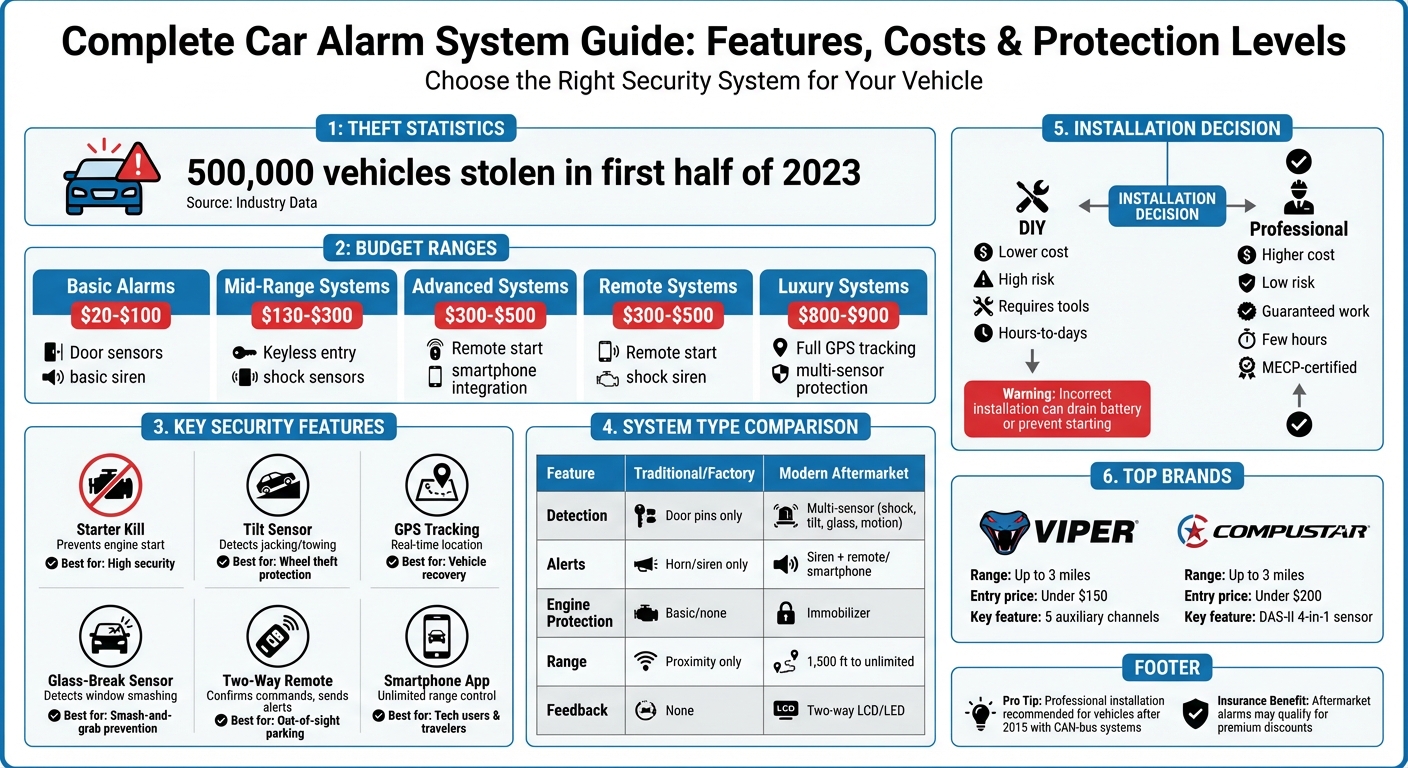
Car Alarm System Features Comparison: Budget Ranges and Security Functions
Determining Your Security Requirements
What to Consider: Vehicle Type, Budget, and Theft Risk
Start by assessing your parking situation. Cars left on streets, in dimly lit areas, or in neighborhoods with higher crime rates are at greater risk of theft. If you typically park far from home or in high-rise parking structures, consider a security system with long-range capabilities or smartphone integration for added convenience and control.
Certain vehicles, like the Honda Civic, Accord, Toyota Camry, and specific pickup models, are statistically more targeted by thieves. Older vehicles – especially those over five years old – or base trims may lack immobilizers, making them easier targets. If this sounds like your car, look for a system with a starter kill feature, which prevents the engine from starting without the proper key.
If your vehicle has aftermarket upgrades or you often leave valuables inside, prioritize systems with glass-break and motion sensors to detect unauthorized access. Trucks with expensive rims or cars parked on urban streets may benefit from tilt sensors, which can guard against wheel theft or towing attempts.
When it comes to cost, basic alarms range from $20 to $100, while mid-range systems offering keyless entry typically cost $130 to $300. Advanced setups with features like remote start and smartphone modules are priced between $300 and $500, and high-end luxury systems can go as high as $800 to $900. It’s worth checking with your insurance provider, as installing a security system might qualify you for premium discounts. Lastly, make sure the system you choose is fully compatible with your vehicle’s electronics.
Checking System Compatibility
Newer vehicles, especially those manufactured after 2015, often use CAN-bus systems and push-to-start ignitions. These require specialized interfaces to ensure proper functionality. To avoid issues like battery drain or electrical malfunctions, verify compatibility using a system builder tool or consult a professional installer. For newer cars, professional installation is highly recommended. If you’re considering adding features like remote start, bundling them during the initial installation can save you money down the line.
Important Features in Car Alarm Systems
Basic Features: Sensors, GPS Tracking, and Remote Access
When evaluating car alarm systems, start with the essential features that provide a solid foundation for vehicle security. Shock sensors are your first line of defense, detecting impacts that could indicate a break-in attempt. Many systems use dual-stage sensors to differentiate between minor bumps and serious threats. Tilt sensors add another layer of protection by activating the alarm if someone tries to jack up or tow your car without authorization.
Glass-break sensors are particularly useful for catching thieves who might smash a window without triggering door sensors. These sensors "listen" for the specific sound frequency of breaking glass and respond instantly. Motion sensors further enhance security by detecting movement inside or around your vehicle, which is especially helpful if you often leave valuables in plain sight.
GPS tracking is a must-have for recovering a stolen car. It provides real-time location data that can be shared with law enforcement. Many systems also include geofencing, which alerts you if your vehicle leaves a designated area. For added convenience, two-way remotes allow you to send commands and receive alerts, even from distances up to 3 miles.
Modern systems often include smartphone integration, giving you control from virtually anywhere. You can arm or disarm the system, monitor door locks, check the interior temperature, and receive instant push notifications. Cloud-based connectivity ensures you’re always in the loop, no matter where you are.
Together, these features create a strong security framework, setting the stage for exploring more advanced options.
Additional Features for Newer Systems
For those seeking extra protection, newer car alarm systems offer advanced features designed to outsmart even the most determined thieves. Starter kill is a standout – this feature disables the engine after an unauthorized entry, making hot-wiring nearly impossible. The engine won’t start until the system is disarmed with your authorized remote.
High-decibel sirens are another powerful deterrent, emitting sound levels between 105–120 dB. Whether you’re in a crowded parking lot or a quiet neighborhood, this ear-piercing alarm is designed to scare off intruders.
To counter tech-savvy criminals, many systems now use encrypted transmission to protect your remote’s signal. Techniques like code-hopping or 66-bit encryption ensure the signal changes with each use, making it nearly impossible to replicate. Additionally, auxiliary outputs allow you to customize your system with add-ons like automatic window roll-up or trunk release modules.
Feature Comparison Chart
Feature
Security Function
Best For
Starter Kill
Disables ignition to prevent hot-wiring
High security
Tilt Sensor
Detects unauthorized jacking or towing
Protecting expensive wheels/tires
Two-Way LCD Remote
Sends alerts and confirms commands from a distance
Owners who park out of sight
GPS Tracking
Provides real-time location monitoring
Recovery after theft
Glass-Break Sensor
Activates alarm when glass-breaking is detected
Preventing "smash and grab" incidents
Smartphone App
Offers remote control and unlimited range alerts
Tech-savvy users and frequent travelers
These advanced features not only enhance security but also offer convenience and peace of mind, making them a worthwhile investment for anyone serious about protecting their vehicle.
Different Types of Car Alarm Systems
Passive vs. Active Alarms
When it comes to car alarms, you’ll often hear about passive and active systems. The key difference lies in how they’re armed. Active alarms require you to arm them manually, typically using a remote. This can be handy if you’re loading or unloading your car and want to delay arming the system. On the other hand, passive alarms arm themselves automatically once the ignition is turned off and the doors are closed. This hands-free approach reduces the chance of forgetting to secure your vehicle.
From there, you can explore advanced features like two-way communication and immobilizer systems, which take vehicle security to a whole new level.
Two-Way Alarms and Immobilizer Systems
Two-way alarm systems are a step up from the older, one-way versions. Instead of just sending commands to your car, these systems keep you in the loop by transmitting information back to you. For instance, if the alarm is triggered, your LCD remote or smartphone will receive real-time alerts. It might even tell you which sensor was activated or if a door is open. Most modern two-way systems have a range of up to 3,000 feet, though obstacles like buildings can affect this distance.
Another powerful feature to consider is the immobilizer system, often referred to as a "starter kill." This prevents the engine from starting if someone tries to access your car without authorization. Many insurance companies recognize this added protection and may even offer discounts on your premiums if your vehicle is equipped with an immobilizer.
Traditional vs. Modern Systems Chart
The chart below breaks down how modern aftermarket alarm systems improve upon the limitations of traditional, factory-installed setups.
Feature
Traditional/Factory Systems
Modern Aftermarket Systems
Detection Method
Door pin triggers only
Shock, tilt, glass-break, and motion sensors
Alert Type
Audible horn/siren only
Audible siren + remote/smartphone notifications
Engine Protection
Basic or none
Immobilizer
Range
Limited to proximity
1,500 ft to unlimited (via smartphone)
Feedback
None
Two-way LCD/LED remote feedback
Factory alarm systems are fairly basic – they typically respond only when a door is opened. In contrast, modern aftermarket systems rely on multiple sensors that detect various threats, like shock or motion. They also provide instant feedback, whether you’re nearby or miles away, ensuring you’re always aware of what’s happening with your car.
Part I – How To Car Alarm Remote Start System Installation
sbb-itb-74b4b25
Recommended Systems from Auto Sound & Security
Auto Sound & Security provides a range of solutions tailored to meet diverse vehicle security needs. Here’s a closer look at two standout brands they offer: Viper and Compustar.
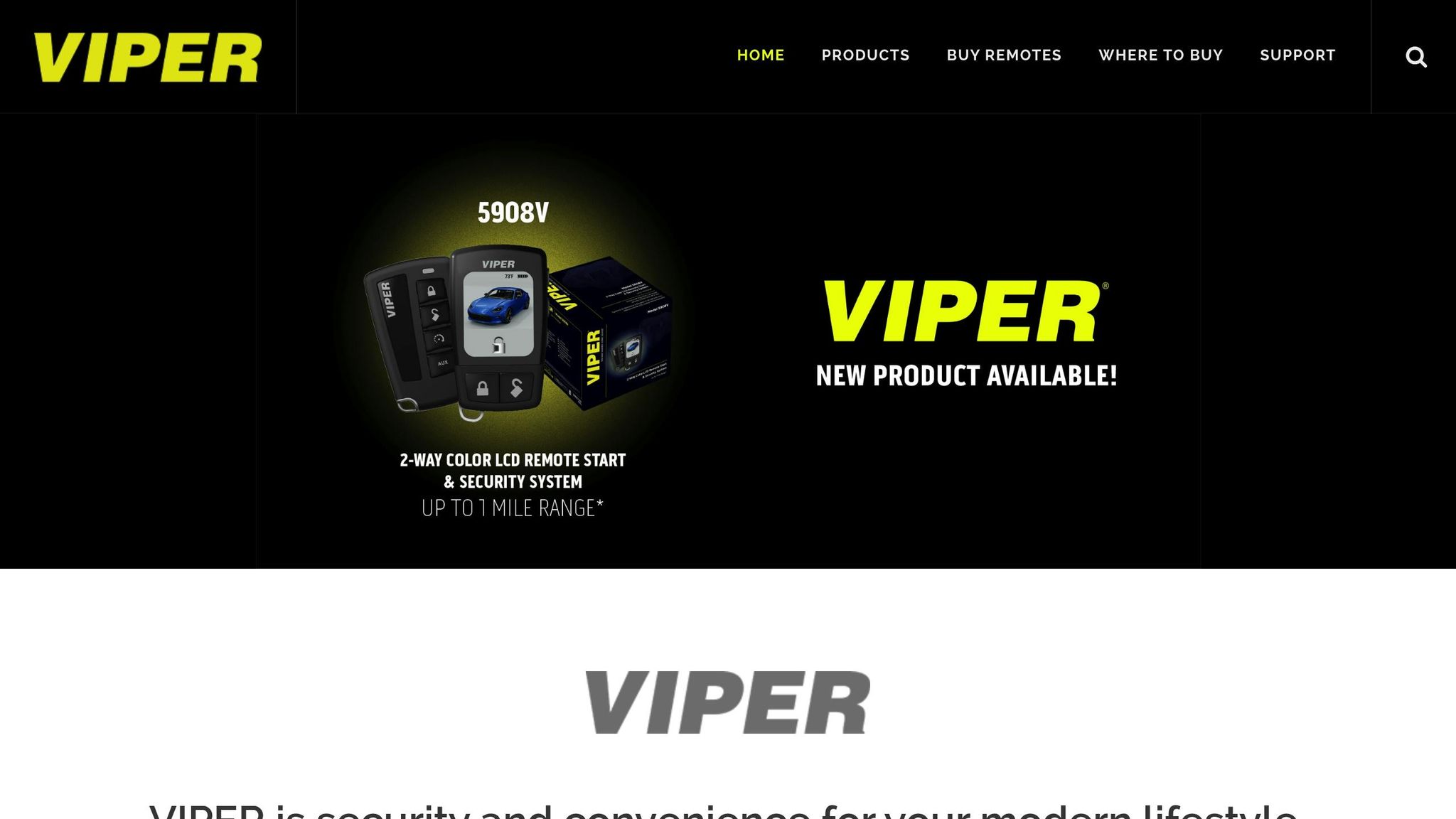
Viper has built a reputation as a leader in vehicle security, offering systems packed with features that go beyond standard alarms. For instance, Viper’s high-performance remotes boast an impressive range of up to 3 miles, giving you the ability to control and monitor your car from far away. The Failsafe Starter Kill is a standout feature – it immobilizes your vehicle by preventing the engine from being started or hot-wired while the alarm is active.
Viper systems are equipped with advanced sensors, including shock, motion, tilt, and glass-break detectors, ensuring your car is well-protected against unauthorized access. With cloud-based modules like Drone LTE, you can receive real-time alerts, track your car’s GPS location, and manage the system via a smartphone app. For added versatility, models like the Viper 3606V include five auxiliary channels, allowing for features like remote start or window control. If you’re looking for a budget-friendly option, the Viper 3105V, priced under $150, has been named the "Best simple keyless entry" system for 2026 by SafeWise.
Compustar: Advanced Technology Systems
Compustar is another trusted name, known for its durable designs and customizable options. A highlight is the DAS-II 4-in-1 security sensor, which combines impact/intrusion detection, tilt monitoring, forward motion sensing, and glass-break detection in one compact unit. Paired with a 105+ dB siren, this system ensures any tampering is quickly noticed by those nearby.
"Adding a starter-kill to your vehicle is one of the best solutions for eliminating car theft. Even if a thief manages to get inside your vehicle, they won’t be able to start the engine until the Compustar security system is disarmed." – Justin Villaflor, Compustar
For those who value range and connectivity, Compustar’s PRO T13 and T12 models offer up to 3 miles of remote range. The DroneMobile (Drone X1 LTE) module takes things further, offering unlimited range, GPS tracking, and push notifications through smartphone integration. If you’re looking for a well-rounded package, the CS7900-AS bundle, priced under $200, comes highly recommended. With a 3,000-foot range and a comprehensive feature set, it has been rated the "Best Bundle" for 2026 by SafeWise. Additionally, Compustar caters to specific needs with features designed for manual transmissions and diesel engines.
Viper vs. Compustar Comparison Chart
Here’s a side-by-side look at what each brand offers:
Both Viper and Compustar deliver robust security solutions, but their unique strengths make them suitable for different preferences and needs. Whether you prioritize range, customizability, or advanced features, these systems have you covered.
Installation and Purchase Considerations
Professional Installation vs. DIY Setup
If your car has modern electronics or limited tools, opting for professional installation is often the better choice. Vehicles made after 2015 typically use CAN-bus systems, which require specialized knowledge and tools for proper integration.
"If you attempt to install an advanced car alarm model and do so incorrectly, it can drain the battery, prevent your car from starting or cause other expensive damage." – Bailey, Content Writer, Abt
Professional installers come equipped with tools like multimeters, soldering irons, and panel removal gear. They also have the expertise to fine-tune shock and motion sensors, reducing false alarms. To ensure quality, look for MECP-certified technicians, as they adhere to industry standards. Companies like Auto Sound & Security offer Basic, Premium, and Custom Packages to meet various needs and budgets.
Feature
DIY Installation
Professional Installation
Cost
Lower (equipment only)
Higher (equipment + labor)
Risk
High risk of wiring errors
Low risk; work is guaranteed
Tools
Requires additional tools
All tools provided
Time
Hours to days
Typically a few hours
Integration
Basic; challenging on CAN-bus
Seamless digital integration
Warranty
Self-supported
Includes labor and product warranty
For those taking the DIY path, it’s crucial to disconnect the negative battery terminal before starting. Never tap into yellow-sleeved wires, as they belong to the airbag (SRS) system. Avoid quick connectors like "Scotch-lock" or T-taps, which are prone to failure. Instead, solder connections and use heat-shrink tubing for durability.
Before making a purchase, confirm your system’s compatibility and warranty details.
Verifying Compatibility and Warranty Coverage
Ensuring your alarm system is compatible with your vehicle is essential. Many retailers offer tools like "Find What Fits" or "Vehicle Selector" to help identify systems based on your car’s year, make, and model. For vehicles with factory immobilizers, you’ll often need a preprogrammed interface module, such as the Fortin EVO-ALL, to ensure the alarm communicates with your car’s computer.
"Not all security systems will work in all vehicles, so we strongly recommend you contact us before you order yours." – Buck Pomerantz, Advisor, Crutchfield
If your car lacks factory power door locks, a standard alarm remote won’t lock or unlock the doors unless additional door actuators are installed. For manual transmission vehicles, check compatibility, as many remote start/alarm combos are designed for automatics.
Warranty coverage is another key factor. Top brands often provide a limited lifetime warranty on the main control module and harnesses, while remotes and accessories usually come with a one-year warranty. Keep in mind that DIY installation may void the warranty, so professional installation is recommended to preserve full coverage.
Smartphone Integration and Extra Features
Once installation and compatibility are sorted, consider alarm systems with smartphone connectivity for added convenience. Systems with smartphone integration allow virtually unlimited range for control and monitoring, as long as cellular service is available. Models like Viper SmartStart and Compustar DroneMobile use 4G LTE or GSM modules to provide instant push notifications, SMS alerts, or even phone calls for events like tampering or geofence breaches. Some apps also let you monitor battery voltage, cabin temperature, fuel levels, and real-time GPS location.
These smartphone features often require a subscription. For instance, DroneMobile’s basic plan costs about $5.99 per month, while Viper SmartStart offers annual plans. Additional hardware modules, priced around $120, may also be necessary.
Equipping your car with aftermarket alarms and GPS tracking could even lead to insurance discounts, helping offset some of the system and subscription costs. When choosing a system, prioritize brands with local authorized dealers, like Auto Sound & Security, to ensure access to timely software updates and support in case of compatibility issues.
Conclusion
Choosing the right car alarm system comes down to understanding your vehicle’s specific security needs and your budget. Aftermarket systems can provide essential protection against theft and break-ins, making them a worthwhile investment.
Start by assessing your risks and focusing on features that align with your parking habits and vehicle type. For example, if you own a high-theft vehicle like a Honda Civic or Ford pickup, or frequently park in high-crime areas, a two-way system with smartphone alerts might be your best bet. On the other hand, if you’re looking for basic protection at a lower cost, a one-way system with features like a starter kill and shock sensors can offer solid coverage for around $130–$160.
Compatibility is key, especially for vehicles built after 2015 that use CAN-bus systems. Installing an incompatible alarm could lead to issues like battery drain or startup problems. Make sure to check that the system works with your vehicle’s make, model, and transmission – particularly if you drive a manual or diesel vehicle. These steps ensure a smoother installation and reliable performance.
Finally, professional installation is highly recommended. Skilled technicians can minimize wiring errors, protect your vehicle’s warranty, and ensure the system is integrated correctly. Plus, many insurance providers offer discounts for vehicles equipped with aftermarket alarms, which can help offset the installation costs.
FAQs
What key features should I look for in a car alarm system?
When picking a car alarm system, focus on options that boost both safety and ease of use. Features like remote start integration let you start your car from afar, adding a layer of convenience. With GPS tracking, you can keep tabs on your car’s location at all times. Systems with smartphone connectivity allow you to receive real-time alerts and manage the alarm through an app, so you’re always in the loop. Look for advanced sensors, such as shock, motion, or tilt detectors, which can identify suspicious activity. A loud siren combined with a dependable remote or key fob ensures you can respond quickly. Make sure the system you choose is compatible with your vehicle and straightforward to install for a hassle-free setup.
How do I make sure a car alarm system is compatible with my vehicle?
To ensure a car alarm system works seamlessly with your vehicle, start by jotting down your car’s make, model, year, and any factory-installed features like keyless entry or remote start. This info is key to matching your car with an alarm system that’s compatible.
When selecting an alarm, check whether it’s labeled as universal or vehicle-specific. Most manufacturers provide compatibility charts that list supported models, making it easier to confirm a match. Also, ensure the alarm system integrates smoothly with your car’s existing electronics, like keyless entry or remote start, so you don’t lose those features.
If you’re unsure, reach out to a professional installer or retailer for guidance. They can cross-reference your car’s details to confirm the alarm will work. Retailers like Auto Sound & Security even offer free compatibility checks, making it easier to choose the right system.
What are the advantages of having a car alarm system professionally installed?
Opting for a professional to install your car alarm system comes with some clear advantages. For starters, skilled installers know how to hide wiring effectively, routing it away from spots that thieves could easily access. This makes it much tougher for anyone to tamper with your system. Plus, they ensure the alarm integrates smoothly with your vehicle’s existing features, like remote start, door locks, and battery monitors, so everything works together without triggering unnecessary alarms.
Another perk? Professional installation usually includes a warranty that covers both the equipment and the labor. If you run into wiring problems or need sensor adjustments later, you’re covered. This combination of expertise and ongoing support ensures your car alarm system stays reliable and effective for the long haul.
To schedule an appointment with your friendly neighborhood experts at Car Repair Services, give us a call at +1 718-470-2223 or fill out the form below with your information and requested services. One of our team members will get back to you as soon as possible to confirm your appointment.
mailing list to receive updates on new arrivals, offers and other discount information.
We use cookies to ensure that we give you the best experience on our website. If you continue to use this site we will assume that you are happy with it.Ok