Car Security Upgrade Checklist: Essential Features
Car theft is a growing concern, with over 850,000 vehicles stolen in 2024 alone – one every 37 seconds. Factory-installed security systems often fall short against modern theft techniques like relay attacks and OBD port hacking. Upgrading your car’s security can make it a harder target and even save you money on insurance.
Key Takeaways:
Advanced Alarm Systems: Look for features like shock, tilt, and glass-break sensors, along with smartphone alerts.
GPS Tracking: Real-time location tracking improves recovery rates by 34%. Geofencing and remote immobilization add extra protection.
Physical Locks: Steering wheel locks, brake pedal locks, and OBD port locks act as visible deterrents.
Immobilizers: Prevent engine start without the correct key code, reducing theft risk by 40% for equipped vehicles.
Dash Cams: Record motion or impact, providing evidence in case of theft or vandalism.
Quick Tips:
Many upgrades qualify for insurance discounts (5%-25%).
Professional installation ensures proper integration with your car’s electronics, especially for CAN-bus systems.
Budget-friendly options include steering wheel locks ($40–$100) and basic alarms ($30–$300).
Upgrading your car’s security isn’t just about theft prevention – it also gives you peace of mind. Whether you park on the street or own a high-risk vehicle, adding layers of protection can make all the difference.
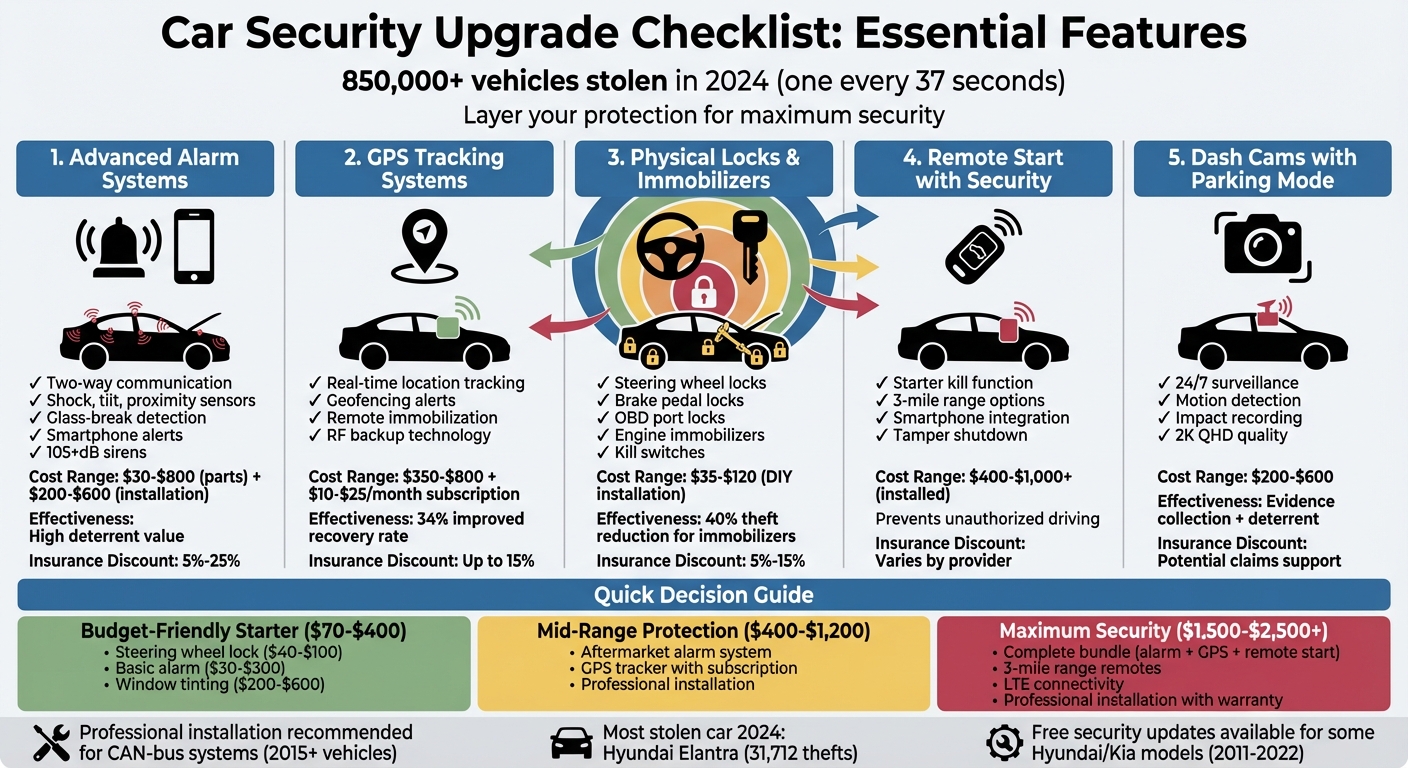
Car Security Upgrade Options: Features, Costs, and Protection Levels Comparison
10 best anti theft things you can do to protect your car from theft!
sbb-itb-74b4b25
Car Security Features Checklist
Protecting your vehicle isn’t just about locking the doors – it’s about layering multiple security measures to address potential vulnerabilities. Here’s a breakdown of the most effective security upgrades available today.
Advanced Alarm Systems
Modern alarm systems go far beyond the old-fashioned sirens. These systems now use smartphone alerts and real-time tracking, making them digital watchdogs for your car. A key feature to look for is two-way communication. Unlike one-way systems that only send commands, two-way remotes provide instant feedback, letting you know if your car doors are locked or if the alarm has been triggered.
An immobilizer is another must-have. It stops thieves from starting your engine by preventing hot-wiring attempts. For vehicles made after 2015, CAN-bus compatibility ensures the alarm integrates seamlessly with your car’s computer system without causing electrical issues or draining the battery.
Today’s alarms also come with advanced sensors that detect break-ins or tampering:
Shock sensors: Triggered by vibrations like glass breaking or forced entry.
Tilt sensors: Alert you if the car is being jacked up or towed.
Proximity sensors: Create an invisible "bubble" around your car, responding to nearby movement.
Glass-break sensors: Calibrated to detect the unique sound of breaking glass.
Light sensors: Monitor enclosed areas like the trunk or glove box for unauthorized access.
"A good security system not only makes your car more difficult to steal, it also makes it easier to live with." – Buck Pomerantz, Crutchfield Advisor
Many insurance companies reward advanced alarm systems with lower premiums. When deciding between passive arming (automatic activation) and active arming (manual activation via remote), think about your routine. Passive arming is convenient, but active systems reduce accidental triggers. For the best results, always opt for professional installation to avoid electrical problems.
GPS Tracking and Vehicle Recovery Systems
GPS trackers take car security a step further by providing precise location data in real time. These devices share your vehicle’s exact coordinates, speed, and direction, making recovery much more likely if it’s stolen. Law enforcement can track the car’s movements, improving the chances of a quick return.
Geofencing is another standout feature. It creates virtual boundaries around locations like your home or workplace and sends alerts if your car leaves these areas without permission. Advanced trackers even include remote immobilization, allowing you to disable the engine via a smartphone app once the vehicle stops. For areas with poor GPS signal, some systems add RF (Radio Frequency) backup technology to locate vehicles in underground garages or inside shipping containers.
"The real power of a tracker isn’t just knowing where your car is, but knowing the moment it’s somewhere it shouldn’t be." – CarLock
Most GPS trackers require a subscription for cellular data, typically costing $9.95 to $20 per month. Installation is often simple, with many devices plugging directly into your car’s OBD-II port (standard in cars made since 1996). High-quality trackers also feature ultra-low power modes to prevent battery drain when the car is parked.
Anti-Theft Devices and Immobilizers
Physical anti-theft tools add an extra layer of protection, working alongside electronic systems to discourage thieves. A combination of visible deterrents and hidden measures is often the most effective approach.
Engine immobilizers rely on a "digital handshake" between a transponder chip in your key and the car’s Engine Control Unit (ECU). Without the correct code, the engine won’t start. These devices have been credited with reducing theft rates by 40% for equipped vehicles.
Physical locks, like steering wheel clubs and brake pedal locks, are simple yet effective. They act as a visible deterrent, forcing thieves to spend extra time and effort, which increases their chances of getting caught. For example, in 2024, the Hyundai Elantra was reported as the most stolen car in the U.S., with 31,712 thefts. Many owners turned to steering wheel locks as an affordable first line of defense.
"The greatest strength of a physical lock is its simplicity. It needs no power, can’t be digitally jammed, and sends a crystal-clear message: ‘This car is protected. Go find an easier target.’" – CarLock
Other tools, like hidden kill switches, block the flow of electricity or fuel to the engine, preventing the car from being driven even if the ignition is bypassed. For vehicles with keyless entry, Faraday bags or pouches shield the key fob’s signal, guarding against relay attacks. OBD port locks are another smart investment, stopping thieves from accessing your car’s internal network to reprogram keys or issue fake commands.
Remote Start Systems with Security Integration
Remote start systems don’t just add convenience – they also enhance security. These systems allow you to start your car remotely to heat or cool it, all while keeping it locked and secure. They include features like starter kill, which prevents the car from being driven without the proper key, even if the engine is running. If someone tries to tamper with the vehicle or shift the transmission, the engine shuts down and the alarm is triggered.
Smartphone integration takes this a step further, letting you control your car from virtually anywhere. For example, the DroneMobile X1 module offers unlimited-range control and GPS tracking. Depending on the features and installation, these systems typically cost $400 to $1,000 or more. Many insurance providers recognize the added security and offer discounts on premiums.
Another bonus? Dash cams with parking mode can be paired with these systems for continuous monitoring, ensuring your car is always under watch.
Dash Cams with Security Features
Dash cams equipped with parking mode provide 24/7 surveillance, recording whenever they detect motion or impact. Whether it’s a parking lot hit-and-run, a break-in attempt, or vandalism, these cameras capture crucial video evidence. Adding a dash cam to your security setup not only deters theft but also gives you peace of mind, knowing you’ll have proof if something happens to your car.
What to Consider When Choosing Security Upgrades
Vehicle Compatibility
Not every security device is a one-size-fits-all solution. Whether a device will work with your car depends on its year, make, model, and the communication systems it uses. Many major manufacturers provide tools online – often called "System Builder" or "Find what Fits" – where you can input your vehicle details to verify compatibility.
For vehicles produced after 1996, OBD-II trackers are the standard. If your car was built after 2015, you’ll need to ensure the device supports CAN-bus systems for seamless integration with factory electronics. Certain modern vehicles with factory-installed immobilizers may also require a preprogrammed interface module, like the Fortin EVO-ALL, to communicate effectively with the car’s computer.
Physical security devices come with their own considerations. For example, when buying a mechanical lock, measure the distance between your pedals and steering wheel or the spacing between the wheel spokes to ensure a proper fit. Similarly, if you’re looking at remote battery disconnect switches, make sure there’s enough clearance – several inches – around the negative battery post to accommodate the smart switch box.
It’s a good idea to consult a specialist or authorized dealer to confirm whether a system will work with your car’s features, such as push-to-start ignition or keyless entry. For instance, knowing whether your car uses a keyed or push-button ignition can help you determine the right type of remote start or security system. These checks will also help you decide whether you’re better off installing the system yourself or hiring a professional.
Professional Installation vs. DIY
Once you’ve confirmed compatibility, the next step is deciding how to install the system. DIY installation can save you money on labor costs, and many products – like dash cams or OBD-II GPS trackers – are designed for straightforward plug-and-play setup. However, DIY projects come with risks. Wiring mistakes can lead to unreliable performance, battery drain, or even damage to your vehicle. You’ll also need the right tools, such as a multimeter and soldering iron, and enough time to plan and execute the installation carefully. Incorrect wiring could even disable safety features like airbags.
"When it comes to car alarms and remote start systems, we recommend professional installation because wiring them into your vehicle can be quite challenging." – Buck Pomerantz, Crutchfield
Professional installation does cost more, but it ensures proper integration with your car’s electronics and reduces the risk of electrical issues. This is particularly important for vehicles with CAN-bus systems, where expert installation helps maintain the functionality of critical features like door locks. If you’re considering a complex alarm or remote start system, professional installation is highly recommended.
Feature
DIY Installation
Professional Installation
Cost
Lower (parts only)
Higher (parts + labor)
Risk
Greater chance of errors
Minimal risk; often includes a warranty
Complexity
Requires tools and time
Handled by trained technicians
Integration
May bypass factory features
Ensures compatibility with factory systems
Setting Your Security Upgrade Budget
Understanding your car’s needs and the complexity of installation will help you set a realistic budget. A well-thought-out budget should cover multiple layers of protection: deterrence (like alarms), prevention (immobilizers), recovery (trackers), and physical reinforcement (locks). Keep in mind both the upfront hardware costs and any ongoing expenses, such as installation fees or subscription services. The type of car you drive and where you park it also matter – a high-risk situation, like street parking or owning a frequently targeted model such as the Chevrolet Camaro ZL1, might justify spending more on advanced systems.
Don’t forget to factor in professional installation costs and GPS tracking subscriptions, which typically range from $10 to $25 per month. Cars built after 2015 often require pricier CAN-bus–compatible systems to integrate safely with factory electronics.
On the bright side, many insurance companies offer discounts – up to 15% – for vehicles equipped with approved anti-theft devices. These savings can help offset your upgrade costs. If you’re working with a tight budget, starting with visible deterrents like steering wheel locks ($40–$100) or window tints ($200–$600) can be an affordable way to boost your car’s security.
Component/Service
Estimated Cost (Parts)
Estimated Cost (Installation)
Basic Alarm Siren
$30 – $300
$200 – $600
Aftermarket Alarm System
$350 – $800
Included or $200+
Wheel Lock Set
$35 – $120+
DIY
Steering Wheel Lock
$40 – $100+
DIY
Window Tinting
$200 – $600
Usually included
GPS Tracking Subscription
$10 – $25/month
N/A
Before buying any hardware, check if your car manufacturer offers free security software updates. For instance, Hyundai and Kia provide a free "ignition kill" update for eligible 2011–2022 models without engine immobilizers. Taking advantage of such programs can help you save hundreds of dollars while still improving your car’s security.
Auto Sound & Security delivers top-tier alarm systems that balance strong security with ease of use. The Compustar CSXP9913-AS stands out as a premium choice. It comes with the PRO T13 remote, offering an impressive 3-mile range and 2-way LCD alerts that vibrate and display notifications when the alarm is triggered. This bundle also includes features like proximity unlock and smartphone control integration, making it a versatile option for vehicle owners. The PRO T13 remote has earned a 4.8/5 star rating from 141 reviews, highlighting its reliability and popularity.
For truck owners or those in tough weather conditions, the Compustar CSX9900-AS is a great alternative. It features a waterproof T12 remote with the same 3-mile range, ensuring durability in harsh environments. Both systems include the DAS-II 4-in-1 sensor, which detects multiple threats such as impact, tilt, forward motion, and glass breakage.
If you’re on a budget, the Compustar CS752-A offers essential protection at an entry-level price. It features a dual-stage shock sensor, a tilt sensor, and a starter-kill relay. While it uses 1-way remotes with a shorter 200-foot range and lacks a 2-way LCD display, it still serves as an effective deterrent against theft.
"Adding a starter-kill to your vehicle is one of the best solutions for eliminating car theft. Even if a thief manages to get inside your vehicle, they won’t be able to start the engine until the Compustar security system is disarmed." – Justin Villaflor, Compustar
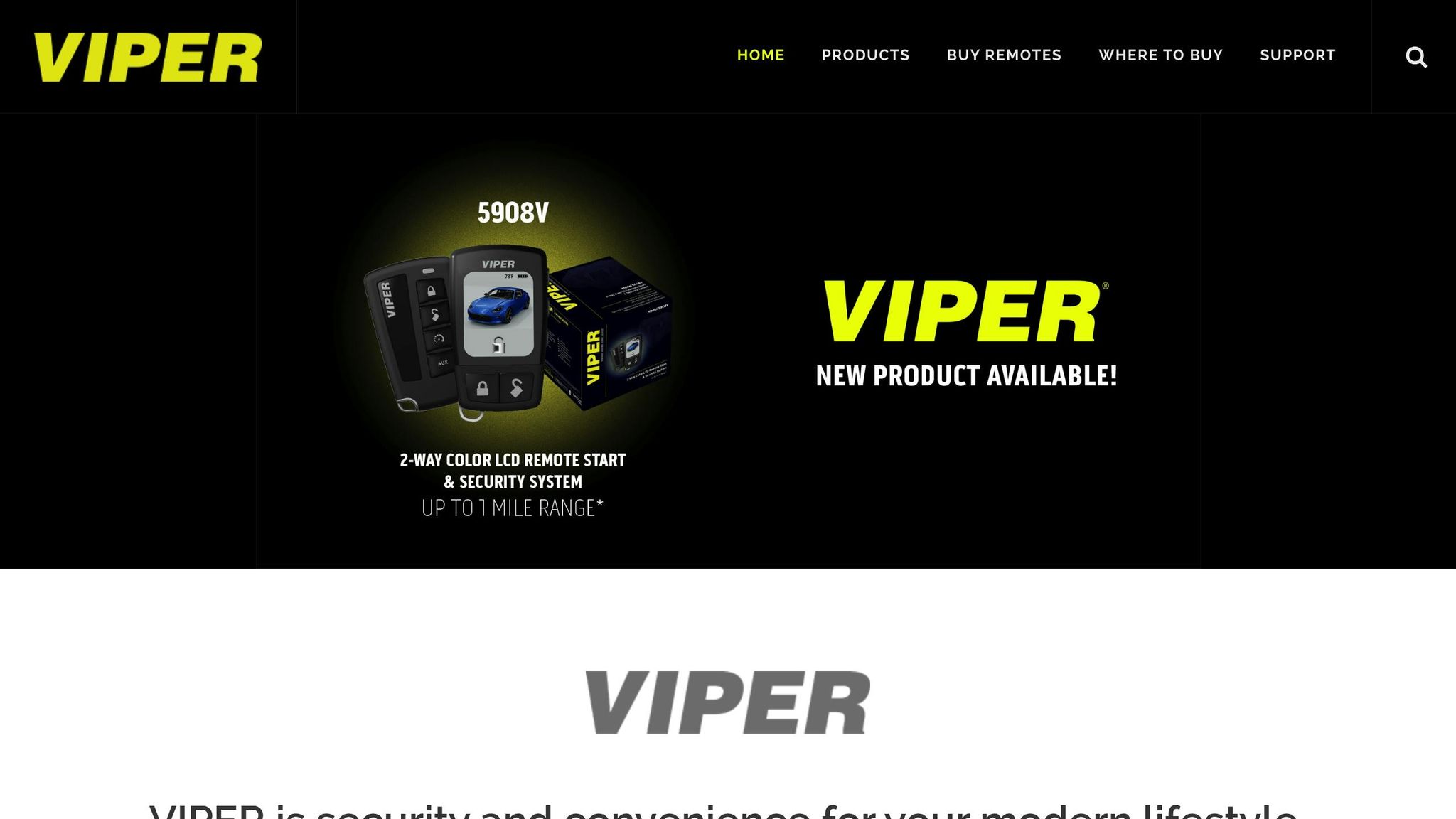
All Compustar systems come equipped with 105+dB sirens, which are far louder than standard factory horns, ensuring a clear and immediate alert if your vehicle is tampered with. Another strong contender is the Viper Model 3606V, which offers five auxiliary channels, allowing for customizable security enhancements.
Best GPS Trackers for Vehicle Recovery
Pairing your alarm system with GPS tracking can significantly improve vehicle recovery. The DroneMobile Drone X1 LTE module is a standout option when used with Compustar systems. It enables real-time vehicle tracking through a smartphone app, a critical feature given that a vehicle is stolen every 32 seconds in the United States. The system sends instant push notifications when the alarm is triggered, and a Premium DroneMobile subscription unlocks full GPS tracking capabilities.
"DroneMobile allows you to stay connected to your vehicle from anywhere with your smartphone… [providing] the additional benefit of GPS tracking with a Premium DroneMobile subscription plan." – Justin Villaflor, Compustar
The Drone X1 is already included in advanced bundles like the CSXP9913-AS and CSX9900-AS, so there’s no need to purchase additional tracking hardware. It also supports geofencing, which alerts you if your vehicle leaves a designated area.
For those who want video evidence alongside GPS tracking, the Drone XC Dash Cam is a solid choice. It combines 2K QHD recording with LTE connectivity and built-in GPS, making it a dual-purpose tool for security and recovery. This is especially relevant given that over one million vehicles were stolen in 2022, the highest number since 2008.
Complete Security Bundles
Auto Sound & Security offers comprehensive bundles that integrate alarms, remote start, and GPS tracking for all-around vehicle protection. These packages are designed to provide multiple layers of security.
The CSXP9913-AS and CSX9900-AS are top-tier options, featuring 3-mile range LCD remotes, the DAS-II 4-in-1 sensor, an E-LOCK starter-kill relay, and the Drone X1 LTE module for smartphone control and GPS tracking. The key difference between the two is the waterproof T12 remote in the CSX9900-AS, making it ideal for truck owners or those in wet climates.
For mid-range budgets, the Compustar CS905-AS offers solid protection. It features 2-way remote start, a 105dB siren, and a 1,500-foot shock sensor range, earning a 4.8/5 star rating from 16 reviews. Another option is the CS4900S-KIT, priced at $449.99 with professional installation included. This model holds a 4.7/5 star rating from 106 reviews, making it a reliable choice.
Bundle Model
Primary Features
Remote Type
Max Range
Best For
CSXP9913-AS
Remote Start, Security, GPS, LTE
2-Way LCD (PRO T13)
3 Miles
Overall Protection
CSX9900-AS
Remote Start, Security, GPS, LTE
2-Way LCD (Waterproof T12)
3 Miles
Trucks & Durability
CS905-AS
Remote Start, Security, Starter-Kill
2-Way Remote Start
1,500 Feet
Mid-Range Budget
CS752-A
Security, Tilt Sensor, Starter-Kill
1-Way
200 Feet
Budget Upgrades
Professional installation is required for these bundles to ensure proper CAN-bus integration. Auto Sound & Security also offers free 2-day shipping on orders over $99, adding convenience to your purchase.
Conclusion: Protect Your Vehicle with the Right Security Features
Upgrading your car’s security isn’t just a good idea – it’s a smart move. With modern thieves finding ways to exploit factory systems, adding aftermarket protection has become more of a necessity than a luxury.
These upgrades go beyond what factory systems offer. Features like tilt sensors, glass-break detection, GPS tracking, and starter-kill relays work together to deter theft and improve recovery chances. Plus, many insurance providers reward these enhancements with premium discounts. In short, these systems turn your vehicle from an easy target into a well-guarded asset.
It’s not just about theft prevention – security systems also bring peace of mind. Real-time alerts and monitoring features keep you informed and in control, no matter where you are.
To get the most out of these systems, professional installation is key. Poor wiring or improper setup can disable essential systems or compromise safety. That’s why Auto Sound & Security’s expert installers are here to help. They ensure your system integrates perfectly with your car, optimizing sensor placement and functionality for maximum effectiveness.
Advanced security features don’t just protect your car – they give you confidence. Auto Sound & Security offers tailored solutions to fit your vehicle and parking needs. Whether you’re looking for a budget-friendly alarm or a high-end system with GPS tracking and extended range, we’ve got you covered. Visit Auto Sound & Security today to explore top brands like Compustar and Viper. Let the professionals protect your vehicle with security features designed specifically for your car.
FAQs
How can upgrading my car’s security system help lower my insurance premiums?
Upgrading your car’s security system is a smart move that could help you save on insurance premiums. Features like anti-theft devices, GPS tracking systems, and advanced alarm systems make your car a tougher target for thieves, which insurance companies tend to reward with discounts.
By adding these security enhancements, you’re not just safeguarding your vehicle – you’re also showing insurers that you’re actively working to lower the chances of theft or vandalism. This proactive approach can translate into noticeable savings on your insurance policy.
What’s the difference between passive and active car alarm systems?
When it comes to car alarms, there are two main types: passive and active systems.
Passive alarm systems kick in automatically as soon as you park your car and shut all the doors. There’s no need to press any buttons or take extra steps – protection is seamless and effortless.
Active alarm systems, on the other hand, require you to manually arm them, usually with a remote or key fob. While this does take an extra step, it gives you the flexibility to decide exactly when the system is activated, which can be handy in certain scenarios.
The choice between the two boils down to what matters most to you – effortless convenience or having more control over your car’s security. Both options are designed to keep your vehicle safe, so it’s all about finding the one that fits your lifestyle.
Why should I consider professional installation for advanced car security upgrades?
For advanced car security systems, professional installation is the way to go. It ensures everything is set up properly and works as it should. Skipping this step can lead to headaches like battery drain, electrical glitches, or even false alarms – problems that could weaken your vehicle’s protection.
Professionals know exactly how to position and connect sensors, wiring, and other components to make the system run smoothly. Their expertise doesn’t just improve how well your security features work; it also helps you avoid future issues. Plus, it gives you that extra confidence, knowing your car is better protected against theft.
To schedule an appointment with your friendly neighborhood experts at Car Repair Services, give us a call at +1 718-470-2223 or fill out the form below with your information and requested services. One of our team members will get back to you as soon as possible to confirm your appointment.
mailing list to receive updates on new arrivals, offers and other discount information.
We use cookies to ensure that we give you the best experience on our website. If you continue to use this site we will assume that you are happy with it.Ok