Off-road lights can only be used legally on public roads if they meet specific federal and state standards. Here’s what makes them compliant:
DOT or SAE Certification: Look for a "DOT" or "SAE" marking on the light lens or housing, indicating compliance with Federal Motor Vehicle Safety Standard (FMVSS) 108.
Beam Pattern: Street-legal lights must have a sharp cutoff to prevent glare, unlike off-road lights that scatter light widely.
Color Restrictions: Only white or selective yellow/amber lights are allowed for on-road use. Colors like blue, red, or purple are prohibited as they are reserved for emergency vehicles.
Mounting Height: Legal mounting height ranges from 16 to 42 inches from the ground. Roof-mounted lights are not allowed for on-road use unless covered with opaque shields.
Integration: Auxiliary lights must work in tandem with factory lights, turning on only when appropriate (e.g., with high beams).
State-Specific Rules: Each state has its own regulations about the number of lights, brightness, and mounting requirements. For example, California fines can reach $238 for violations.
Non-compliant lights can result in fines ranging from $50 to $500 and may pose safety risks, including glare that endangers other drivers. Proper installation, including correct wiring and beam alignment, is essential to meet legal standards and ensure safety on the road.
DOT and FMVSS 108 Compliance Requirements
What is FMVSS 108?
Federal Motor Vehicle Safety Standard 108 (FMVSS 108) is the main regulation overseeing automotive lighting, signaling, and reflective devices in the U.S. It’s outlined in Title 49 of the Code of Federal Regulations, Part 571, Section 108, and is managed by the National Highway Traffic Safety Administration (NHTSA), part of the U.S. Department of Transportation. This standard sets specific requirements for things like luminous intensity, beam patterns, and color consistency to ensure proper roadway illumination. For example, headlamp intensity cannot exceed 150,000 candela, and the minimum mounting height must be 22 inches.
"The purpose of this standard is to reduce traffic accidents and deaths and injuries… by providing adequate illumination of the roadway, and by enhancing the conspicuity of motor vehicles on the public roads." – 49 CFR § 571.108
FMVSS 108 also mandates that off-road lights must work in tandem with factory headlights without interfering with critical lighting functions. These guidelines are essential for determining whether off-road lights can legally be used on public roads, directly tying them to DOT certification standards.
DOT Certification Explained
DOT certification builds on FMVSS 108 by enforcing compliance through a self-certification system. Manufacturers must test and confirm that their lighting products meet all FMVSS 108 requirements before they can be sold. Each headlamp or auxiliary light must display a permanent "DOT" mark, either molded or printed on its lens. This mark acts as the manufacturer’s declaration that the product adheres to federal safety and performance standards.
It’s important to note that while the "DOT" mark is mandatory for headlamps and daytime running lights, it is optional for other signal lighting devices. Products labeled "off-road use only" do not meet federal requirements for street use. Familiarity with these regulations is crucial when installing off-road lights for use on public roads.
sbb-itb-74b4b25
SAE Standards for Auxiliary Lighting
SAE J581: Beam Patterns and Intensity Requirements
SAE J581 outlines the standards for auxiliary high beam lights designed to work alongside factory high beams, improving both long-distance visibility and overall performance. Unlike traditional spotlights with a narrow focus, SAE J581-compliant lights are engineered to project light further while offering a broader spread to illuminate the road shoulders.
"SAE J581 is the SAE standard for an auxiliary high beam driving light… intended to help in the overall performance of your factory high beams and extend your distance visibility." – OGA LED
These lights must emit white light – selective yellow is not allowed. The beam pattern for compliance is approximately 20° horizontal by 8° vertical, ensuring focused illumination over long distances while minimizing unnecessary light scatter. To avoid glare, these auxiliary high beams should be turned off when approaching or following other vehicles.
Proper installation is key. SAE J581 lights should be mounted at the same height as the factory headlights and aimed directly forward to avoid creating shadows or hood glare. Mounting on the A-pillar or roof is discouraged, as it can cause hood glare that may interfere with night vision.
Supplementing vs. Replacing Headlights
Auxiliary lights are designed to supplement, not replace, factory headlights. SAE J581 lights lack the features, such as low-beam patterns and controls, required for primary headlamps. They operate in tandem with factory high beams and only activate when those beams are in use.
Attempting to replace factory headlights with auxiliary lights can lead to legal and safety complications. SAE-compliant auxiliary lights are specifically designed to enhance the existing lighting system, ensuring they meet both safety and legal standards for use on public roads. Understanding these distinctions is critical for proper installation and compliance.
Tacoma Street Legal Fog Lights – Baja Designs Squadrons SAE vs Sport
Installation Guidelines for Legal Compliance
Ensuring your auxiliary lights are installed correctly is crucial for meeting legal standards and avoiding penalties.
Mounting Height and Position
Placement matters for street legality. Most regulations require lights to be mounted between 16 and 42 inches from the ground, measured from the lamp’s center to the street surface. The mounting height determines whether your lights qualify as legal auxiliary lamps or fall into the category of prohibited off-road equipment.
For compliance, auxiliary lights must be installed at or below the factory headlight level. Roof-mounted light bars, even with DOT certification, are not permitted for on-road use because they exceed the legal headlight height. If lights are mounted above 42 inches – like those on a roof rack – they must be covered with opaque covers when driving on public roads to avoid citations.
Additionally, most states restrict civilian vehicles to two forward-facing auxiliary lights. Lights should be securely mounted to rigid vehicle parts to ensure they remain unobstructed.
State
Legal Mounting Height (Inches)
Maximum Auxiliary Lights Allowed
Georgia
16 – 42
One auxiliary driving light
Indiana
24 – 42
One auxiliary driving lamp
Maryland
16 – 42
Two auxiliary lamps
Mississippi
12 – 42
Two auxiliary driving lamps
Nevada
16 – 42
Two auxiliary lamps
Texas
16 – 42
Two auxiliary driving lamps
Washington
16 – 42
Two auxiliary lights
West Virginia
Maximum 42
Lamps above 42 inches must be covered
Once the lights are mounted correctly, the next step is wiring them safely and effectively.
Wiring Requirements
Auxiliary lights must integrate with your factory lighting system to remain street-legal. SAE J581-compliant auxiliary high beams should connect to your vehicle’s high-beam circuit, ensuring they only turn on when your factory high beams are active. This setup prevents accidental glare that could blind oncoming drivers.
To wire auxiliary lights, use two circuits:
A high-amperage battery circuit protected by a 30-amp fuse and relay
A low-amperage control circuit powered by a fused 12v source via a switch
Most auxiliary lights draw more power than a standard in-cab switch can handle, which is why a 12v DC 30/40 amp automotive relay is essential.
"Most lights will [draw] more power than your average in-cab switch can handle, whereas the right relay can handle the voltage safely, and handle bigger power requirements down the line." – Garrett Davis, AmericanTrucks
Install a 30-amp fuse close to the battery to protect the main circuit, and use a smaller 10-amp fuse for the in-cabin switch circuit. Choose 10 to 14 gauge wire based on the power draw, with larger diameters (smaller gauge numbers) helping to prevent overheating. Always run a dedicated ground wire to a factory ground point or the negative battery terminal rather than relying on self-grounding.
For the control circuit, connect the switch to a 12v line that only receives power when the ignition is in the "on" or "accessory" position. This prevents accidental battery drain when the vehicle is off. Adding a manual override switch is also a good idea, especially in states requiring off-road lights to remain covered on public roads.
Once wired, the final step is ensuring the beam is properly aimed for optimal performance and compliance.
Beam Aiming and Direction
Accurate beam alignment ensures safety and legal compliance. To prevent glare, the brightest part of the beam should be aimed 2 inches below the horizontal centerline at 25 feet.
To adjust your lights:
Park your vehicle 3 feet from a flat wall.
Mark the vertical and horizontal center of each light on the wall with painter’s tape.
Add a second horizontal line 2 inches below the first.
Back up your vehicle to exactly 25 feet from the wall.
Adjust the vertical aiming screws until the beam’s brightest point aligns with or falls below the lower tape line.
Horizontally, ensure the beam pattern is centered directly ahead of each light to prevent it from spilling into oncoming traffic lanes. If you’re installing LED bulbs in reflector housings, position the LED chips to face left and right, allowing the reflectors to direct the light properly and avoid scattered glare.
Forward-facing auxiliary lights must emit white or amber light only. Red and blue lights are reserved for emergency vehicles. Stick to a color temperature between 3,000K and 6,000K – anything above 6,500K (blue-tinted) is often illegal and increases glare. Street-legal lights should feature a sharp, clean cutoff line at the top of the beam to prevent upward light scatter.
State-Specific Regulations and Enforcement
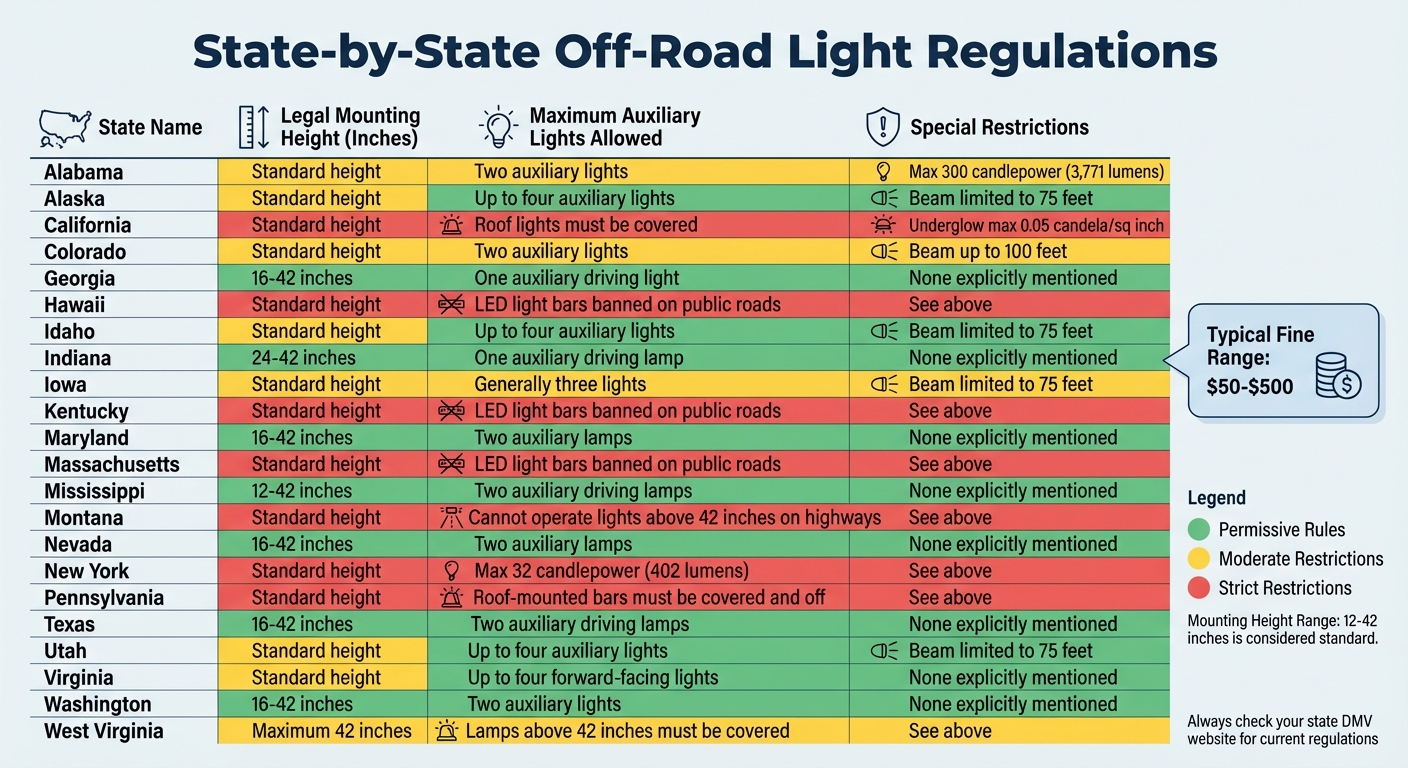
State-by-State Off-Road Light Regulations: Mounting Heights and Legal Limits
State-by-State Rules
Lighting laws can vary widely depending on where you live, so it’s important to check your state’s specific requirements before installing auxiliary lights. While federal DOT and SAE standards provide a general framework, states have their own rules about the number of lights you can use, how bright they can be, and where they can be mounted.
Take Alabama and Colorado, for example – they allow up to two auxiliary lights. Meanwhile, states like Alaska, Idaho, and Utah permit up to four. Virginia also allows up to four forward-facing lights, but Iowa generally caps the number at three. Some states, such as Hawaii, Kentucky, and Massachusetts, outright ban LED light bars on public roads, restricting them to off-road use only.
Beam projection is another area where rules differ. States like Alaska, Arizona, Idaho, Iowa, Oklahoma, Rhode Island, Utah, and Wyoming usually limit beam distance to about 75 feet. On the other hand, states like Colorado, Maryland, Minnesota, and Tennessee allow beams to stretch up to 100 feet. Brightness limits also vary: Alabama enforces a maximum of 300 candlepower (roughly 3,771 lumens), while New York sets a much stricter limit of 32 candlepower (about 402 lumens).
Mounting and covering rules are also in place in many states. For example, Pennsylvania and West Virginia require roof-mounted off-road light bars to be switched off and covered with opaque covers when driving on public roads. California allows underglow lighting but only if it doesn’t exceed 0.05 candela per square inch, and it cannot use red, blue, or flashing colors. Meanwhile, Montana prohibits operating lights mounted higher than 42 inches on highways.
To find out exactly what’s allowed in your state, check your state DMV website or look up the Vehicle Code under "Equipment" or "Lighting." Also, ensure your lights have DOT or SAE compliance markings to avoid potential issues.
Knowing these rules is essential, but understanding how they’re enforced is just as important.
Enforcement Practices and Penalties
Law enforcement plays a key role in ensuring compliance with these varying lighting regulations. Officers can stop drivers for unsafe auxiliary lighting even if there isn’t a specific light bar law, often citing general "unsafe vehicle" rules when lights cause glare or create hazards. Most enforcement focuses on banned colors – such as red, blue, or purple – and flashing or strobing effects, which are reserved for emergency vehicles.
During inspections, officers typically check that auxiliary lights are mounted between 16 and 42 inches from the ground and that roof-mounted lights are covered and turned off when driving on public roads. Fines for lighting violations range from $50 to $500. Repeat offenses can lead to more severe penalties, such as impoundment, license suspension, or even registration revocation. In some areas, a basic lighting ticket might cost less than $50, but ignoring the violation can lead to escalating consequences.
To avoid fines, make sure your roof-mounted light bars have opaque covers when driving on public roads, switch any RGB lighting to a steady white mode before heading onto highways, and ensure your auxiliary lights meet federal DOT standards and your state’s specific rules.
Auxiliary Lights vs. Off-Road Lamps: Key Differences
Understanding the distinctions between auxiliary lights and off-road lamps is essential, especially when it comes to staying compliant with on-road regulations. Unlike off-road lamps, auxiliary lights adhere to strict DOT and SAE standards, ensuring their beam patterns are controlled and designed to minimize glare for other drivers. Off-road lamps, on the other hand, prioritize maximum light output with unrestricted beam patterns, which makes them unsuitable for on-road use.
Beam patterns are a standout difference. Auxiliary lights, like fog and driving lights, are engineered with precision optics. For instance, fog lights typically produce a wide 100° horizontal by 8° vertical spread, while driving lights use a narrower 20° horizontal by 8° vertical beam. In contrast, off-road lamps feature high-intensity flood, spot, or combo patterns that lack the vertical cutoff needed for on-road safety. Sparksmith explains:
"Off-road spot lights do not necessarily have a well controlled pattern like a driving light and should never be used on the road".
Certifications and mounting also set these two apart. Auxiliary lights must display SAE markings – J581 for driving lights or J583 for fog lights – and are mounted at regulated heights, typically between 12″ and 42″ from the ground, aligning with legal standards. Off-road lamps, however, often lack certifications or carry a "For Off-Road Use Only" label. These are typically mounted high, such as on the roof or windshield, which violates on-road mounting rules.
Wiring is another area of difference. Auxiliary lights must integrate with the vehicle’s factory high or low beam circuits, and many states require them to have a separate switch for operation. Off-road lamps are wired independently and must remain off while on public roads. In states like California and Pennsylvania, they even need to be covered with opaque shields when not in use.
For clarity, here’s a quick side-by-side comparison of auxiliary lights and off-road lamps:
Comparison Table: Auxiliary Lights vs. Off-Road Lamps
Feature
Auxiliary Lights (Street-Legal)
Off-Road Lamps (Non-Street-Legal)
Certifications
SAE J581 (Driving), SAE J583 (Fog), DOT
None or "For Off-Road Use Only"
Mounting Height
12″ to 42″ from the ground; mounted at or below the headlights
Mounted high (roof or windshield)
Beam Pattern
Controlled with a sharp cutoff to prevent glare
High-intensity flood, spot, or combo without cutoffs
Wiring
Tied to factory high/low beam circuits; separate switch usually required
Independent switch; must remain off on roads
Color
White or Amber/Yellow
White (blue/red prohibited)
On-Road Use
Permitted as supplemental lighting
Prohibited; requires opaque covers
These differences not only affect performance but also determine whether the lights can legally be used on public roads. Choosing the right type depends on your specific needs and whether you plan to drive on-road, off-road, or both.
Conclusion
To wrap things up, let’s revisit the key points to ensure your off-road lights meet street-legal standards.
Making off-road lights compliant isn’t just about avoiding fines (typically between $100 and $200) or passing state inspections – it’s about ensuring safety for everyone on the road. Non-compliant lights can cause dangerous glare, blinding oncoming drivers and increasing the risk of accidents.
Here’s what you need to keep in mind:
Look for DOT/SAE markings on your lights, as they indicate compliance.
Mount your lights at the correct height – between 16 and 42 inches, no higher than your factory headlights.
Use lights with a sharp beam cutoff to avoid unnecessary glare.
"Legality is not just an optional feature; it is the core of a safe and reliable product."
One common mistake to avoid is swapping LED bulbs into halogen housings. This violates FMVSS 108 due to improper beam focus and can lead to safety issues. If you’re using off-road lamps for trail adventures, remember that in states like California, they must be covered with opaque shields when driving on public roads.
For more complex setups, seeking professional assistance can save you a lot of trouble. Experts like Auto Sound & Security specialize in installing car lighting systems that comply with regulations while ensuring top-notch performance. They can help with everything from mounting the lights correctly to integrating them into your vehicle’s electrical system.
Simply put, compliance isn’t just about following the rules – it’s about protecting yourself, your wallet, and everyone sharing the road. Taking the time to install your lights properly ensures a safer driving experience for all.
FAQs
How can I tell if my lights are truly DOT/SAE compliant?
To determine if your lights comply with DOT/SAE standards, check for the DOT stamp on the lights. This stamp confirms they meet federal safety regulations for street use in the U.S. Additionally, ensure they are SAE approved. While SAE approval reflects product quality, it doesn’t automatically mean the lights are legal for street use. Make sure both standards are met to confirm compliance with street-legal requirements.
Can I legally use a roof light bar on the street if it’s covered?
A roof light bar can be legal for street use if it’s covered. Many regulations mandate that off-road lights must either be covered or switched off while driving on public roads. This rule helps reduce glare and distractions for other drivers. Be sure to check your local laws to stay compliant.
Will installing LED bulbs in halogen housings make my headlights illegal?
Installing LED bulbs in halogen housings can indeed make your headlights illegal. Halogen housings are engineered for the specific brightness and beam patterns of halogen bulbs. When you replace them with LED or HID bulbs, it can lead to glare and scattered light, potentially blinding other drivers. Unless the entire headlight assembly is DOT-approved specifically for LED use, this setup may violate federal safety standards.
To schedule an appointment with your friendly neighborhood experts at Car Repair Services, give us a call at +1 718-470-2223 or fill out the form below with your information and requested services. One of our team members will get back to you as soon as possible to confirm your appointment.
mailing list to receive updates on new arrivals, offers and other discount information.
We use cookies to ensure that we give you the best experience on our website. If you continue to use this site we will assume that you are happy with it.Ok