Does tinting your car windows void the warranty? Not entirely. Federal law protects your warranty under the Magnuson-Moss Warranty Act, meaning manufacturers cannot void it just because you’ve installed aftermarket tint. However, if the tint or its installation directly damages a specific part of your car, the warranty for that part might be denied.
Here’s what you should know:
Installation Quality Matters: Poorly installed tint can cause issues like damaged door mechanisms or defrosters, which could lead to denied claims.
State Laws Apply: Each state has specific rules for window tint darkness (measured by VLT). Violating these laws could result in fines or insurance complications.
Professional Installation is Key: Certified technicians ensure proper installation, protecting both your car and the tint’s warranty.
Keep Documentation: Always retain proof of installation and compliance with state laws to avoid disputes.
Stick to legal limits, choose a trusted installer, and maintain records to ensure your warranty stays intact.
What you should know before you get your windows tinted
sbb-itb-74b4b25
Does Window Tinting Void Your Factory Warranty?
No, getting your windows tinted doesn’t automatically void your entire factory warranty. Thanks to federal law, manufacturers can’t cancel your warranty across the board just because you made an aftermarket modification. Key systems like the engine, transmission, and other unrelated components remain covered. However, if improper tint installation directly damages a part, that specific component might lose its warranty coverage.
For a manufacturer to deny a warranty claim, they must provide clear proof that the tint or its installation caused the issue. They can’t simply blame the tint and reject all claims. Let’s break down when warranty denials are justified and tackle some common misunderstandings.
When Manufacturers Can Deny Warranty Claims
Manufacturers are within their rights to deny claims if the tinting process directly damages certain parts of your vehicle. For example, if removing windows for tinting harms door mechanisms or leads to water-related electrical problems, they may refuse to cover those repairs.
This is why professional installation is so important. Certified technicians, like those at Auto Sound & Security, follow strict procedures to protect your vehicle’s electronics and other sensitive components during the tinting process.
Another potential issue arises when the tint exceeds legal limits. For instance, in Georgia, the law requires a minimum of 32% light transmittance. Installing darker tint not only risks fines up to $200 but could also create warranty complications. Still, unless the tint directly causes damage, your warranty remains unaffected.
Understanding these scenarios helps separate legitimate warranty denials from myths.
Common Myths About Warranty Voiding
One widespread myth is that dealerships can force you to use specific brands or installers to maintain your warranty. This isn’t true. Unless the manufacturer provides those products or services for free, they cannot require you to use their preferred options.
Another misconception is that manufacturers can deny claims without evidence. In reality, automakers must prove that the tint caused the problem. Federal law even encourages them to provide a written explanation for any denial. If a service advisor tries to deny your claim without proof, you have the right to challenge it.
"A warrantor cannot, as a matter of law, avoid liability under a written warranty where a defect is unrelated to the use by a consumer of ‘unauthorized’ articles or service." – Federal Trade Commission
Ultimately, your factory warranty remains intact unless the tint directly damages a specific component.
The Magnuson-Moss Warranty Act is designed to protect consumers from unfair warranty practices. Specifically, it ensures that manufacturers cannot void your warranty or deny coverage simply because you installed an aftermarket product, such as window tint. This law applies broadly to all consumer products, including vehicles.
Under this Act, manufacturers are required to prove that a modification – like window tinting – directly caused a component failure before they can reject a warranty claim. They must provide clear evidence linking the modification or its installation to the issue at hand. Below, we’ll break down what the Act covers and provide examples of valid and invalid warranty denials.
Another key provision of the Act is its prohibition of "mandatory purchasing requirements." This means manufacturers cannot force you to use specific brands, authorized dealers, or particular service providers to maintain your warranty – unless they provide those products or services at no cost. Any warranty terms demanding the use of specific brands or services are, therefore, unenforceable.
What the Magnuson-Moss Warranty Act Covers
This law ensures that consumers can use aftermarket parts or independent service providers without automatically losing their warranty coverage. If a manufacturer denies your claim, they must give you a written explanation showing how the modification directly caused the failure. If you win a warranty dispute under this Act, you may also be entitled to recover court costs and attorney fees.
It’s worth noting that federal court cases involving warranty disputes generally require a minimum of $50,000 in controversy. Alternatively, you could join a class action lawsuit, provided there are at least 100 named plaintiffs.
"The Magnuson-Moss Warranty Act makes it illegal for car manufacturers to void consumer warranties or deny coverage because an individual installed an aftermarket product versus an original equipment part or service."
These protections establish clear rules for warranty claims, which we’ll illustrate with examples below.
Examples of Valid and Invalid Warranty Denials
Let’s look at some scenarios to better understand how this works. For instance, if your car has an aftermarket modification like window tinting, the manufacturer must show that the tint directly caused the issue before denying a warranty claim.
Here are a couple of examples:
If you install aftermarket springs to lower your car, the manufacturer cannot deny a warranty claim for a faulty power door lock since the suspension modification is unrelated to the door lock’s failure.
On the other hand, if oversized wheels and tires are proven to have caused premature axle failure, the manufacturer can deny the warranty claim for the axle repair.
The same principle applies to window tinting. For example:
Scenario
Warranty Status
Reason
Water from tint installation damages window motor
Can be denied
Clear evidence of causation is provided
Tint removal process breaks door mechanism
Can be denied
Damage directly caused by installation
The bottom line? Manufacturers must prove that a modification directly caused the damage before they can deny a warranty claim. Without that evidence, your warranty remains intact.
State Window Tinting Laws and Warranty Impact
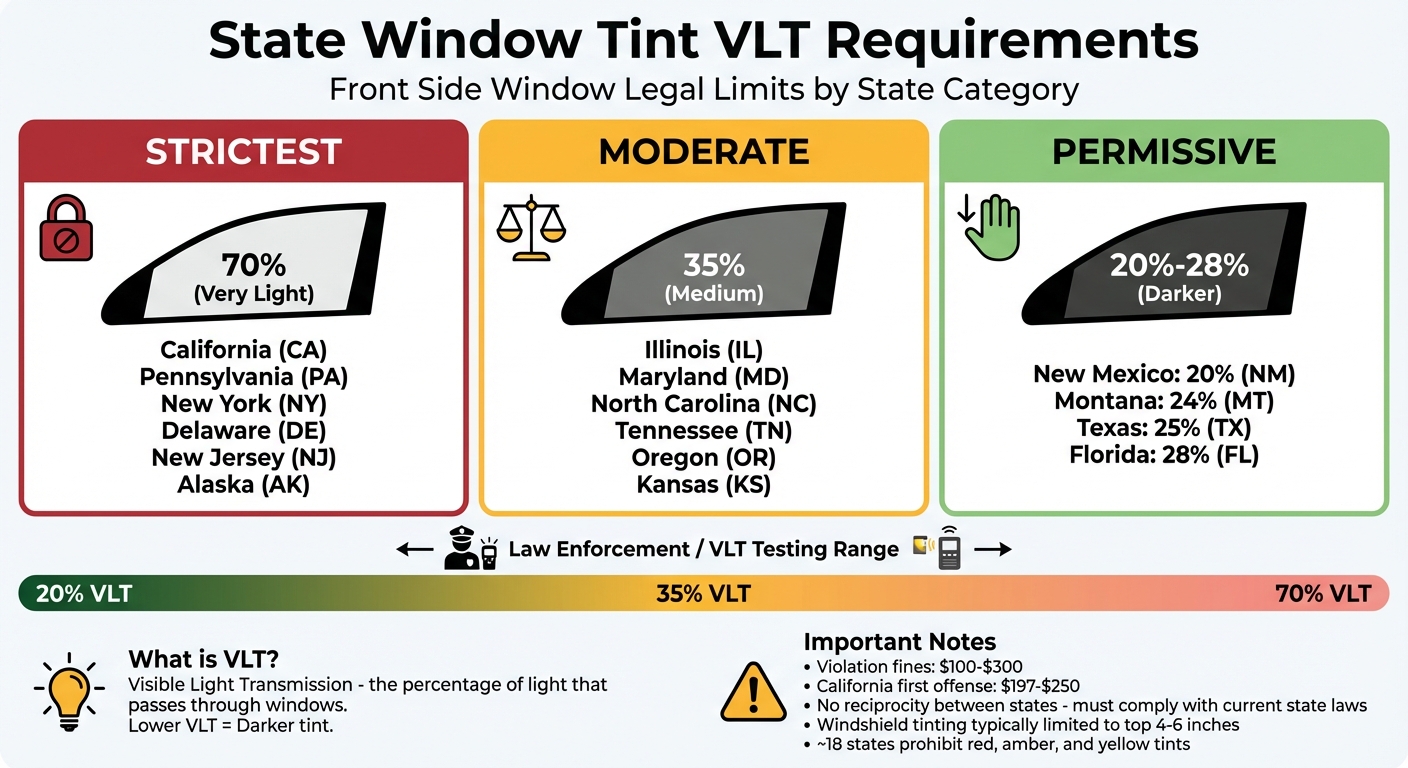
State Window Tint Laws: VLT Requirements by Strictness Level
The Magnuson-Moss Warranty Act ensures that your factory warranty can’t be outright denied due to modifications like window tinting. However, state tinting laws still play a big role – not because they void warranties, but because violating them can create issues with insurance claims, safety inspections, or even legal liability. For example, if you’re involved in an accident and overly dark tint is cited as a factor in reduced visibility, your insurance company might challenge your claim. Staying within legal limits can help you avoid these headaches.
Window tint darkness is measured by Visible Light Transmission (VLT) – the percentage of light that passes through your windows. The lower the VLT, the darker the tint. Factory glass already blocks some light, typically between 15% and 25%, which means adding aftermarket tint creates a combined effect. For instance, applying a 50% tint to factory glass with an 80% VLT results in a net VLT of 40% (0.50 × 0.80 = 0.40). Many drivers unintentionally violate state laws by not accounting for this cumulative effect.
Common Tinting Restrictions by State
Each state has its own rules for window tinting, and compliance is key. Front side window VLT requirements range from 20% in New Mexico to 70% in states like California, New York, and Pennsylvania. Penalties for violations can include fines between $100 and $300, as well as the cost of removing the tint. For example, a first offense in California might set you back $197 to $250.
State Category
Front Side VLT Requirement
Examples of States
Strictest
70% VLT (Very Light)
CA, PA, NY, DE, NJ, AK
Moderate
35% VLT (Medium)
IL, MD, NC, TN, OR, KS
Permissive
20%–28% VLT (Darker)
NM (20%), MT (24%), TX (25%), FL (28%)
In many states, windshield tinting is limited to the top 4–6 inches or must stay above the manufacturer’s AS-1 line. Additionally, around 18 states prohibit certain tint colors, such as red, amber, and yellow, to prevent confusion with emergency vehicles. To enforce these rules, law enforcement often uses portable VLT meters during traffic stops.
Checking Compliance Before Installation
Before adding tint, it’s a good idea to have your factory glass measured to ensure the combined VLT will meet your state’s requirements. Also, check the AS-1 line on your windshield – applying tint below this line could result in a citation.
"No reciprocity agreements exist for window tint laws between states – vehicles must comply with regulations in whatever state they’re currently operating." – Jason Thompson, Carvira
Keep all installation documentation handy, including VLT compliance certificates, as some states require proof of legality. In some cases, certification stickers must be placed between the tint film and the glass. If you have a medical condition like lupus or melanoma that requires darker tint, you’ll need a signed affidavit from your doctor. Always carry this documentation with you to avoid potential legal issues.
How to Protect Your Warranty When Tinting Windows
Keeping your warranty intact when tinting your car windows boils down to making the right choices: selecting the correct tint film, working with certified professionals, and keeping detailed records.
Choosing the Right Tint Film
The type of tint film you choose can directly affect your warranty and your car’s performance. Many modern vehicles rely on technologies like GPS, Bluetooth, and safety sensors, which can be disrupted by certain films. Metallic films, for instance, might block these signals, potentially leading to warranty issues with your car’s electronics.
Instead, opt for ceramic or carbon films. These options provide excellent heat and UV protection while ensuring compatibility with electronic systems. Ceramic films stand out for their top-tier heat rejection and durability, though they tend to cost more. Carbon films, on the other hand, strike a balance by offering strong UV protection and signal compatibility at a more affordable price.
Film Type
Heat/UV Protection
Electronic Interference
Durability
Dyed
Poor
None
Low (fades to purple)
Metalized
Good
High (blocks signals)
High
Carbon
Excellent
None
High
Ceramic
Superior
None
Highest
To further ensure quality, stick with trusted brands like 3M, LLumar, or FormulaOne. These brands offer adhesives that protect your window seals and defroster lines, and their products often come with lifetime limited warranties covering issues like bubbling, peeling, or fading. Many of these warranties are even transferable if you sell your car.
Why Professional Installation Matters
Having your tint installed by a certified professional is crucial for preserving both your vehicle’s warranty and the warranty on the film itself. Many premium tint manufacturers, such as 3M, only honor their warranties if the film is applied by an authorized dealer. As 3M explains:
"3M Window Films require professional application; only authorized 3M Window Film Dealers are thoroughly trained and experienced in performing high quality work."
Certified professionals bring expertise and proper tools to the job. They avoid risky practices like removing glass or panels and use precise, computerized cutting machines to prevent scratches. Plus, they work in controlled environments to eliminate debris contamination. Before committing to a shop, confirm they are an authorized dealer of your chosen film brand, and ask about their cutting methods and workspace conditions.
Documentation and Records to Keep
Once your tint is installed, keeping thorough documentation is essential. The most important document is your original invoice, which should include details about the purchase, the vehicle, and the installation date. This invoice must also list specific technical details, as Tint World emphasizes:
"It is required by the Film Manufacture to provide the Film Type, VLT Percent and Roll Number to receive the warranty."
Before leaving the shop, ensure your invoice includes the following:
The film brand and type (e.g., ceramic or carbon)
The Visible Light Transmission (VLT) percentage
The roll number of the film used
Many manufacturers use the roll number to process warranty claims, so this detail is critical. Additionally, you should receive a warranty certificate with a unique warranty ID and a certificate of guarantee. Some warranties also require registration within 30 days of installation to remain valid.
Store both physical and digital copies of all documents. Keep the originals in your glove box and scan them for backup. This well-organized paper trail will simplify any future warranty claims and help you avoid potential disputes.
Mistakes to Avoid When Tinting Your Vehicle
Even with high-quality window film, poor installation can jeopardize your warranty. Understanding the common pitfalls is crucial to safeguarding both your investment and your vehicle’s coverage.
Warning Signs of Poor Tinting Services
Choosing the wrong installer can lead to costly mistakes. Uncertified technicians may damage your vehicle’s internal components, which could void your warranty. For example, some shops remove windows or door panels during the tinting process, risking harm to internal door mechanisms. This kind of damage could give manufacturers a reason to deny warranty claims.
Be wary of shops offering unusually low prices. These often indicate the use of subpar films or skipped steps in the installation process. Cheap films tend to bubble, peel, or fade within 1–2 years, compared to the 15-year lifespan of quality ceramic films. For reference, professional tinting for a sedan typically costs between $250 and $500. Shops charging far less may be cutting corners.
Another red flag is the absence of calibrated light meters or a clean, controlled workspace. Improperly installed tint can lead to illegal levels of light transmission. For instance, in Georgia, front side windows must allow at least 32% of visible light to pass through. Violating this law could result in fines up to $200 plus court costs.
These risks underscore the importance of avoiding do-it-yourself (DIY) methods, which come with their own set of challenges.
Risks of DIY Window Tinting
While DIY tinting might seem like a cost-effective option, it often creates more problems than it solves. One major issue is the lack of formal documentation, such as receipts, film specifications, and visible light transmission (VLT) percentages. Without these, you’ll have a hard time defending against warranty disputes.
DIY mistakes are common and can significantly lower your vehicle’s resale value. Issues like trapped debris, uneven cuts, and damaged seals not only look unprofessional but also provide manufacturers with grounds to deny warranty claims. For instance, improperly applied tint can cause seals to fail or even break.
Unlike professional installations, DIY jobs don’t come with the precision or documentation required to maintain your warranty. High-end manufacturers like 3M only honor warranties when their films are installed by authorized dealers. If problems like bubbling or peeling occur, you’ll be left unprotected. Considering that professional installations cost between $250 and $500 and often include a lifetime warranty, the risks of DIY tinting far outweigh the initial savings.
Conclusion
Getting your windows tinted the right way ensures your factory warranty stays intact. Thanks to the Magnuson-Moss Warranty Act, manufacturers must prove that your window tint directly caused a failure before they can deny coverage. This federal law protects your rights, but it’s crucial to follow proper procedures and ensure your tint meets all regulations.
One key factor is compliance with state VLT (Visible Light Transmission) laws, which can vary significantly across the U.S. Failing to meet your state’s VLT requirements can be considered product misuse, potentially voiding your film warranty and even leading to fines that may exceed $200.
Choosing a professional installer is essential. Certified technicians not only ensure your tint meets state laws but also follow manufacturer guidelines and document the entire process. This documentation can be crucial if you ever face a warranty dispute. Brands like 3M, LLumar, and Avery Dennison back their warranties only when their products are installed by certified professionals. For peace of mind, consider trusted experts like Auto Sound & Security (https://autosoundnyc.com) for a compliant and high-quality installation.
Lastly, always keep your installation records. Without proper documentation, proving your tint was installed correctly and adheres to legal standards can become a significant challenge.
FAQs
How can I prove tint didn’t cause a warranty issue?
To make sure window tinting doesn’t jeopardize your warranty, have it installed by certified professionals using products approved by the manufacturer. Warranties are usually voided only if the tint directly causes damage or compromises a seal. Thanks to the Magnuson-Moss Warranty Act, manufacturers cannot void a warranty simply because you added aftermarket tint unless it can be proven that the tint caused the problem. Keep all documentation of the installation to back up your claim if needed.
Will my insurance claim be affected if my tint is illegal?
If your car’s window tint doesn’t meet state regulations, it could cause issues with your insurance. Getting a ticket for illegal tint might not only lead to fines but could also raise your insurance premiums. To avoid these problems, make sure your tint adheres to the legal standards in your state.
What’s the easiest way to confirm my final VLT is legal?
To make sure your final VLT (Visible Light Transmission) is within legal limits, the simplest option is to have it tested with a light meter at a professional tinting shop or an inspection station. This guarantees it meets the specific requirements of your state. Since laws can differ greatly depending on your location, always double-check the regulations in your area.
To schedule an appointment with your friendly neighborhood experts at Car Repair Services, give us a call at +1 718-470-2223 or fill out the form below with your information and requested services. One of our team members will get back to you as soon as possible to confirm your appointment.
mailing list to receive updates on new arrivals, offers and other discount information.
We use cookies to ensure that we give you the best experience on our website. If you continue to use this site we will assume that you are happy with it.Ok