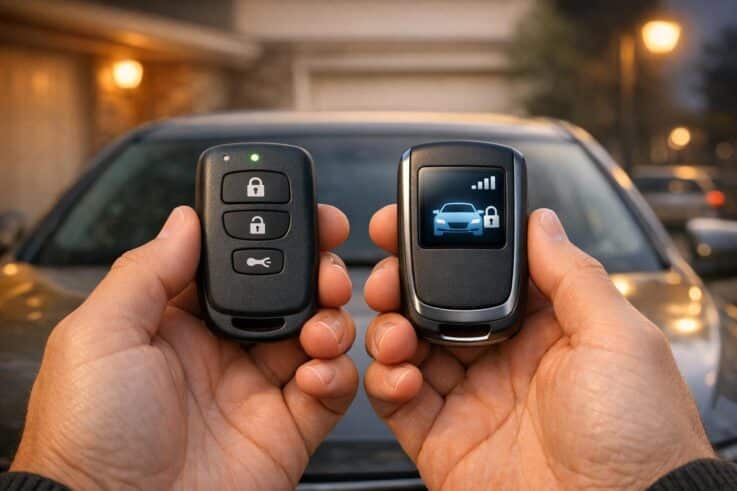
If you’re deciding between a one-way and two-way car alarm, here’s what you need to know:
One-way alarms send commands to your car (like locking the doors) but don’t confirm if the action worked. They’re budget-friendly and effective for basic security but require you to be nearby to see or hear the alarm.
Two-way alarms provide feedback to your remote, confirming commands and alerting you if your car is tampered with – even from miles away. They’re ideal for high-risk areas or vehicles with valuable contents but cost more upfront.
Quick Comparison
Feature
One-Way Car Alarm
Two-Way Car Alarm
Communication
Remote to car only
Bidirectional (car to remote too)
Feedback
None on remote
Alerts via sound, visuals, or vibration
Range
200–500 feet
1,500 feet–3 miles
Alerts
Siren only
Real-time notifications
Cost
$60–$130
$130–$450+
If you park in low-risk areas, a one-way alarm might suffice. But for real-time notifications, extended range, and added peace of mind, a two-way system is worth considering – especially in high-theft areas.
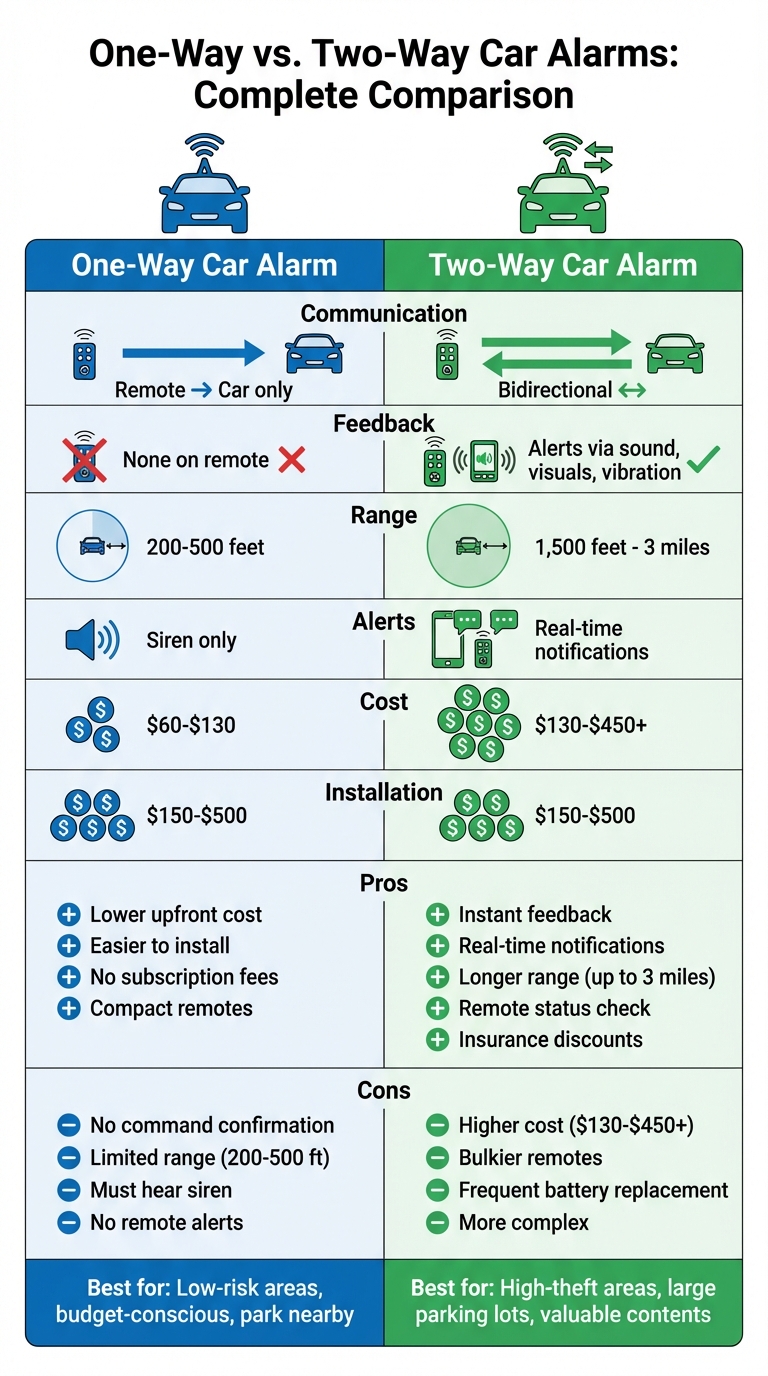
One-Way vs Two-Way Car Alarms: Feature Comparison Chart
What Are One-Way Car Alarms?
How One-Way Alarms Work
One-way car alarms operate by sending commands from your remote to your vehicle’s system. When you press a button on the remote, a digital code is transmitted via radio waves – either AM or FM frequencies – to the car’s control module. This triggers actions like locking the doors, arming the alarm, or opening the trunk.
"Think of a one-way remote like the remote for your television. When you press a button on the remote, it transmits a signal. The only way to know whether the signal transmission worked is to observe the television doing what you requested." – BestCarAudio.com
Unlike two-way car alarms with remote start, one-way alarms don’t send feedback to the remote. You’ll need to rely on visual or audible cues, like flashing parking lights or a chirping siren, to confirm the command worked. If you’re too far away – beyond about 1,320 to 2,000 feet – the signal may not reach the vehicle, leaving you unsure if the action was successful.
Despite this limitation, one-way alarms come equipped with key security features that make them effective for basic vehicle protection.
Standard Features of One-Way Alarms
One-way alarm systems typically include a range of essential security and convenience features. The remote arm and disarm options allow you to secure or unlock your car while simultaneously locking or unlocking the doors. To deter theft, many systems feature a starter kill, which prevents the engine from starting unless the alarm is disarmed.
Shock sensors are another common component, designed to detect impacts to the vehicle. These often have dual-stage sensitivity: a light tap triggers a warning chirp, while a stronger impact activates the full alarm. Other useful features include a panic button to sound the siren, a trunk release for remote access to cargo, and an LED light inside the cabin that serves as a visible deterrent to potential thieves. Some models even offer passive arming, which automatically secures the vehicle 30 seconds after you exit.
sbb-itb-74b4b25
What Are Two-Way Car Alarms?
How Two-Way Alarms Work
Two-way car alarms create a two-way communication link between your car and its remote control. When you press a button on the remote, the command is sent to your vehicle, much like a traditional one-way system. However, what sets two-way systems apart is that your car sends a response back to the remote, confirming the action with beeps, vibrations, or visual notifications.
"With two-way wireless, the control panel and remote devices bi-directionally communicate with each other, meaning that it works like a phone conversation where the devices are able to pass information back and forth." – Tim Myers, Senior Product Manager, Tyco Security Products
If someone tampers with your car – say, by breaking a window or opening a door – the remote will immediately notify you of the breach.
Some two-way systems go above and beyond, offering communication ranges of up to 3 miles, far surpassing the 200–500 feet typical of one-way alarms. Even more advanced models integrate with smartphones through telematics platforms, providing unlimited range and features like real-time GPS tracking, as long as both your vehicle and phone have cellular coverage. This connectivity opens the door to a host of advanced functionalities.
Main Features of Two-Way Alarms
Two-way systems come equipped with remotes that display your car’s status in real time. LCD remotes often have backlit screens with animations showing details like whether the engine is running, the doors are locked, or which sensor triggered the alarm. LED remotes, on the other hand, use blinking lights and sound cues for updates.
These systems go beyond basic locking and unlocking. Many can monitor critical information about your vehicle. For example, LCD remotes might display the interior temperature, battery voltage, or alert you to tampering detected by wireless sensors. A standout example is the Compustar T11, which is built to last with waterproofing that allows it to survive submersion in up to 1 meter of water for 30 minutes.
Another key feature is starter-kill circuitry, which prevents the engine from being started without the correct remote. With car thefts in the United States rising by 30% between 2019 and 2022, these advanced security measures are becoming increasingly important for protecting your vehicle.
One-Way vs. Two-Way Car Alarms: Side-by-Side Comparison
Feature Comparison Table
Feature
One-Way Car Alarm
Two-Way Car Alarm
Communication Direction
Remote to vehicle only
Bidirectional (remote to vehicle & vehicle to remote)
Confirmation Feedback
None on remote (must watch/listen to car)
Visual (LED/LCD), audible (beeps), and haptic (vibration)
Typical Range
200 feet to 500 feet
1,500 feet to 3 miles
Security Alerts
Siren only
Real-time pager alerts when the alarm is triggered
Vehicle Status Monitoring
Cannot verify remotely
Can check armed/locked status from a distance
Cost
Generally less expensive
Higher initial investment
Range and Feedback Differences
The table above highlights the major distinctions between one-way and two-way car alarms, but let’s dig deeper into how these differences affect everyday use and security. These factors can make a big difference in choosing the right system for your needs.
The most noticeable differences are the communication range and feedback capabilities. One-way alarms typically operate within 200 to 500 feet, which means you need to stay relatively close to your car for the remote to work. On the other hand, two-way alarms significantly extend this range, with basic models covering 1,500 to 3,000 feet. Some premium systems, like the Compustar PRO T13, can even reach up to 3 miles.
"If you’re close enough to the vehicle, the alarm system will pick up the transmission… However, if you’ve already entered a shopping mall, an apartment building or a large office, the signal from your [one-way] remote might not be powerful enough." – BestCarAudio.com
Another big difference is the feedback – or lack thereof. With a one-way alarm, you’re left wondering if your command to lock or arm the vehicle was successful unless you’re close enough to see or hear the car respond. Two-way systems remove this uncertainty by confirming actions through LED lights, LCD displays, sound alerts, or even vibrations on your remote.
When it comes to security, the gap becomes even wider. Two-way alarms offer real-time notifications if something triggers the system, such as a break-in, glass breakage, or even towing attempts. With a one-way alarm, you’d only know about these incidents if you’re within earshot of the siren.
For even greater flexibility, smartphone-based systems using telematics provide virtually unlimited range via cellular connectivity. However, these systems often require a subscription fee to maintain the service.
Pros and Cons of Each Alarm Type
Pros and Cons Comparison Table
The differences between one-way and two-way car alarms result in unique benefits and limitations, making each suitable for different needs.
Aspect
One-Way Car Alarms
Two-Way Car Alarms
Advantages
• Lower upfront cost (starting around $60-$130) • Easier to install and use • No ongoing subscription fees • Compact, lightweight remotes
• Instant feedback on commands • Real-time notifications when triggered • Longer range (up to 3 miles) • Ideal for high-crime areas • Remote vehicle status check • Potential insurance discounts
Disadvantages
• No confirmation of commands • Limited range (200-500 feet) • Requires being close enough to hear the siren • No remote alerts for triggered alarms
• Higher upfront cost ($130-$450+) • Installation can cost more ($150-$500) • Bulkier remotes with LCD screens • Batteries need frequent replacement • More complex operation
The practical impact of these differences depends on how and where you use your vehicle. If you typically park in low-risk areas or close to home, a one-way car alarm offers basic protection at a budget-friendly price. On the other hand, if you park in large lots, high-rise garages, or areas prone to theft, a two-way system provides added peace of mind with real-time alerts and extended range. Plus, some insurance companies reward the added security of two-way alarms with discounts, helping to balance out the higher costs over time.
"One-way alarm systems, either active or passive, are good enough to protect most cars and drivers. But if you live in a higher-risk area that has a larger crime rate, investing in a two-way system may be worth the extra money." – Bailey, Content Writer, Abt
For vehicles left in high-risk locations or those containing valuable equipment, the real-time notifications from two-way systems can be a game-changer, alerting you immediately to any tampering attempts. These factors are crucial when deciding on the best security solution for your car.
Auto Sound & Security offers a range of trusted security solutions from Viper and Compustar. Whether you’re looking for a straightforward one-way alarm system or an advanced two-way model with smartphone integration, their lineup has options to suit various security needs. Two-way systems, in particular, excel at providing real-time feedback, offering an added layer of security.
One standout option is the Compustar PRO T13, which features a full-color LCD screen, an impressive 3-mile range, and a micro-USB rechargeable battery. Other models, like the Compustar T11 and T12, also boast a 3-mile range and are built for durability with an IPX7 waterproof rating. For those who prefer smartphone control, the Compustar CSX2WQ900-A pairs a Q9 LCD remote with a 3,000-foot range and LTE connectivity through DroneMobile, enabling you to monitor your vehicle and receive instant alerts on your phone.
"2-way alarm alerts instantly notify you whenever your car alarm is triggered – helping to prevent theft from the moment a break-in occurs." – Justin Lee, Compustar
These systems go beyond basic sirens by incorporating DAS-II sensors, which detect glass breakage, towing attempts, wheel theft, and dual-stage shock impacts. This layered approach ensures comprehensive protection, making these alarms a strong choice for high-risk scenarios.
Professional Installation and Support
To get the most out of these advanced systems, professional installation is key. Expert installers at Auto Sound & Security ensure that the alarm’s control module is properly wired into your vehicle’s ignition harness and integrated with power door locks and starter-kill circuitry, effectively preventing hot-wiring attempts. They also fine-tune the shock, tilt, and glass-break sensors for precise activation, reducing the likelihood of false alarms.
Installation costs typically range from $150 to $500, depending on the complexity of your vehicle and the system being installed. This investment is worthwhile, as professional installation ensures optimal performance. Proper antenna placement maximizes communication range, and expert integration guarantees long-term reliability. As an authorized dealer for both Viper and Compustar, Auto Sound & Security provides access to certified replacement parts, valid warranties, and ongoing support, giving you confidence that your system will perform when you need it most.
Conclusion
Key Takeaways
Deciding between a one-way and two-way car alarm boils down to your security priorities and budget. One-way alarms are a cost-effective option, offering basic protection by sending commands to your car without feedback. These are ideal if you live in a low-risk area and can easily hear the siren. On the other hand, two-way alarms act as a personal security system, notifying you instantly – via remote or smartphone – if someone tampers with your car, even from up to 3 miles away. This feature is especially valuable given the ongoing high rates of vehicle theft.
The numbers back it up: investing in a reliable alarm system can save you money in the long run. Two-way systems equipped with advanced sensors, such as those that detect glass breakage, towing, or impacts, provide multiple layers of protection. Real-time alerts let you act quickly, potentially preventing theft and avoiding significant financial losses.
Professional installation is key to getting the most out of your alarm system. Properly calibrated sensors and seamless integration with your car’s electronics minimize false alarms and ensure maximum security. Installation costs generally fall between $150 and $500, and many insurance providers offer discounts for vehicles with professionally installed alarms.
If you live in a high-crime area, park in spots prone to vehicle theft, or often leave valuables in your car, a two-way alarm system offers peace of mind with its instant alerts. Systems with smartphone integration and GPS tracking take it a step further, providing unlimited range and the ability to locate your car if it’s stolen. Ultimately, the right choice depends on finding a balance between your security needs and your daily lifestyle.
1-Way vs 2-Way What’s the Difference? | Remote Starters
FAQs
Will a two-way alarm alert me inside a building?
Yes, a two-way alarm keeps you in the loop by sending notifications directly to your remote. This way, you’ll know if your vehicle’s alarm goes off, even when you’re inside a building or away from the car.
Do two-way car alarms need a monthly subscription?
Two-way car alarms generally operate without the need for a monthly subscription. These systems rely on remote signals and alerts, allowing them to function without recurring service charges. That said, certain advanced features – like app-based controls or monitoring services – might come with extra costs. It’s a good idea to review your alarm system’s features carefully to determine if any additional fees apply.
Can a car alarm help me get an insurance discount?
Yes, getting a car alarm installed can often lead to insurance savings, usually ranging from 2% to 10%. This is particularly beneficial if you carry comprehensive coverage. Car alarms lower the chances of theft or vandalism, which in turn makes your vehicle a smaller risk for insurance companies.
To schedule an appointment with your friendly neighborhood experts at Car Repair Services, give us a call at +1 718-470-2223 or fill out the form below with your information and requested services. One of our team members will get back to you as soon as possible to confirm your appointment.
mailing list to receive updates on new arrivals, offers and other discount information.
We use cookies to ensure that we give you the best experience on our website. If you continue to use this site we will assume that you are happy with it.Ok