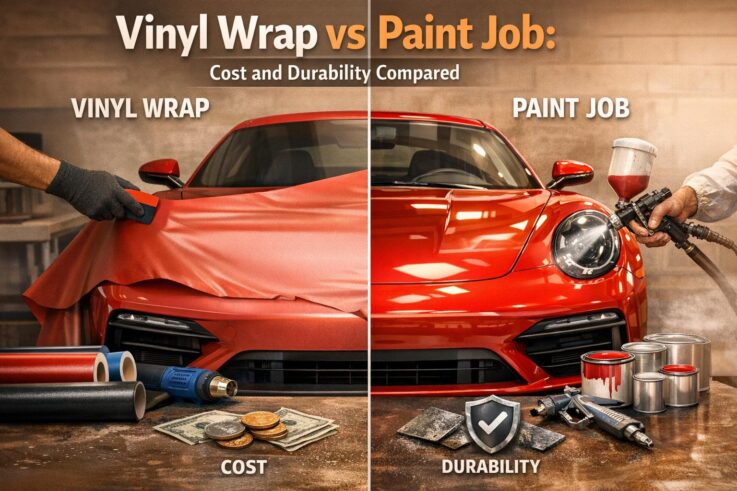
Vinyl Wrap vs Paint Job: Cost and Durability Compared
Looking to change your car’s look but unsure whether to choose a vinyl wrap or a paint job? Here’s the quick breakdown:
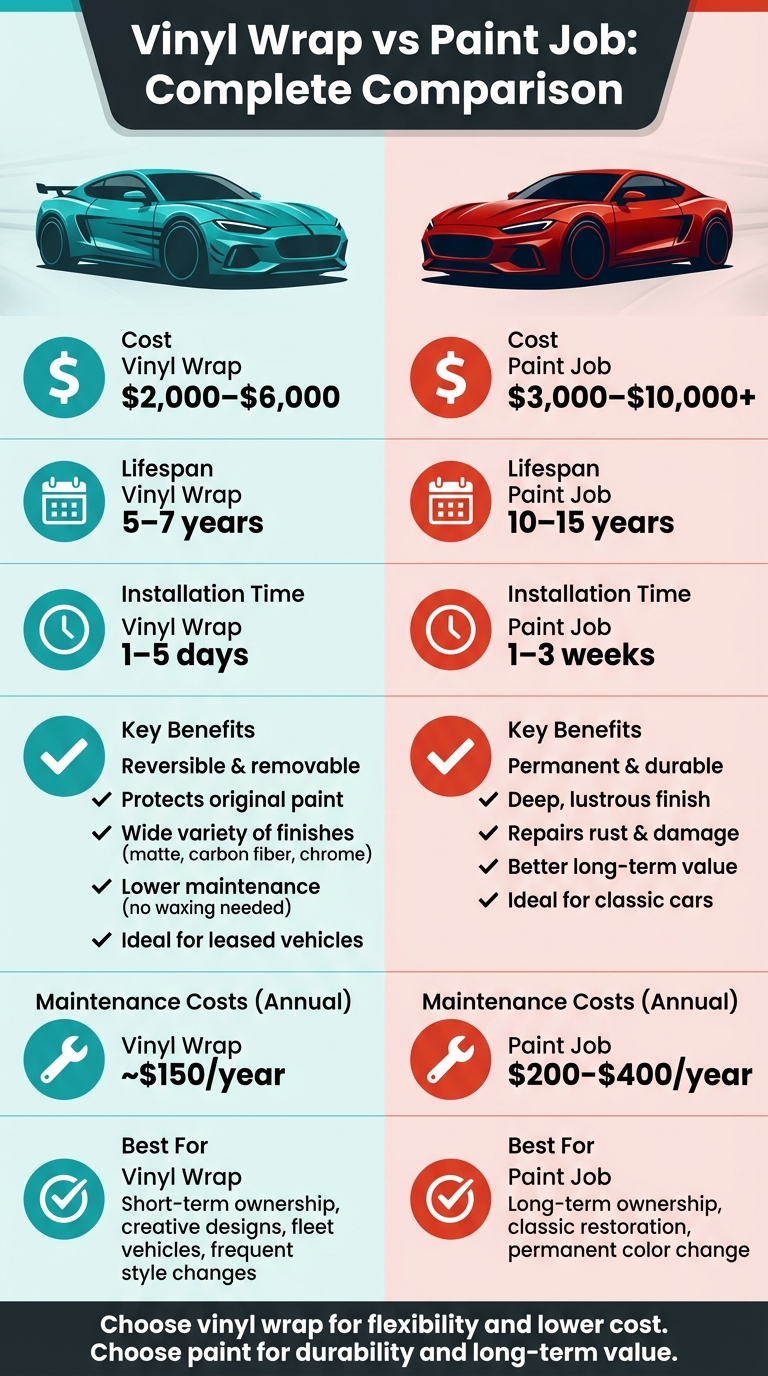
Vinyl Wrap: Costs $2,000–$6,000 on average, lasts 5–7 years, offers reversible designs, and protects the original paint. Great for short-term changes or creative finishes like matte or carbon fiber.
Paint Job: Costs $3,000–$10,000+ for quality work, lasts 10–15 years, and provides a permanent, polished finish. Ideal for long-term ownership or restoring older vehicles.
Quick Comparison
Feature
Vinyl Wrap
Paint Job
Cost
$2,000–$6,000
$3,000–$10,000+
Lifespan
5–7 years
10–15 years
Customization
Wide variety, reversible
Permanent, classic look
Durability
Protects paint, replaceable
Long-lasting, repairable
Installation Time
1–5 days
1–3 weeks
Maintenance
Easy, no waxing
Requires waxing, polishing
If you want flexibility and lower costs, go for a vinyl wrap. For a durable, long-term solution, a paint job is the better choice.
Vinyl Wrap vs Paint Job Cost and Durability Comparison Chart
Vinyl Wraps: How They Work and What They Offer
What is a Vinyl Wrap?
A vinyl wrap is a thin, flexible PVC film that’s applied directly over your vehicle’s paint, offering both a fresh look and a layer of protection. The process begins with a thorough cleaning and degreasing of the car’s surface. Once prepped, the vinyl is measured, cut to fit the car’s curves, and applied using tools like squeegees and heat guns to ensure a smooth finish. Technicians then tuck the edges securely and use heat to seal the wrap in place.
What makes vinyl wraps stand out is the sheer variety of finishes available. Beyond the standard gloss, you can choose matte, satin, carbon fiber, brushed metal, or even color-shifting films that change hue depending on the angle of view. For those seeking something even more unique, industrial printers can create photorealistic 3D graphics and textures, such as leather or snakeskin, offering customization options that go far beyond traditional paint jobs.
Advantages of Vinyl Wraps
Vinyl wraps come with several practical perks. For starters, they’re significantly more affordable than high-end professional paint jobs – often costing 40% to 60% less. For example, wrapping a sedan typically costs between $2,500 and $5,000, while larger vehicles can range from $3,200 to $6,000.
Another advantage is the speed of installation. Compared to the lengthy process of a paint job, wraps are applied much faster. They also act as a protective shield for your car’s factory paint, guarding against UV rays, bird droppings, tree sap, road debris, and minor scratches. This protection can help preserve your vehicle’s resale value.
Perhaps the most appealing benefit is that wraps are reversible. If you want to restore your car to its original look or try a new design, the wrap can be professionally removed without damaging the paint underneath. This flexibility is especially useful for leased vehicles or for anyone who likes to switch up their car’s appearance. Professional removal typically costs between $500 and $1,000.
How Long Vinyl Wraps Last and How to Care for Them
The lifespan of a vinyl wrap depends on its quality and care. High-quality wraps generally last 5 to 7 years, while premium cast vinyl can stretch that lifespan to 7–12 years with proper maintenance. For example, a 2019 BMW X5 wrapped with 3M 1080 series vinyl by a certified installer in San Diego retained 95% of its original appearance after six years. In contrast, a similar vehicle wrapped by an inexperienced shop showed significant wear, such as edge lifting and fading, after only three years.
Caring for your vinyl wrap is relatively simple. Hand washing your car weekly with a pH-neutral car shampoo (pH 6–8) and a soft microfiber mitt is ideal. Avoid automatic car washes with brushes or high-pressure sprays, as these can damage the edges of the wrap or cause peeling. It’s also important to remove contaminants like bird droppings or fuel spills promptly to prevent staining. Unlike paint, vinyl wraps don’t need waxing or polishing – in fact, many waxes can harm the film.
To extend the life of your wrap, park in shaded areas or use a breathable car cover to minimize UV exposure, which can cause the vinyl to degrade over time. Watch for signs of wear, such as browning or cracking, as these indicate the wrap may be nearing the end of its lifespan. Removing the wrap before the adhesive bonds permanently to the paint is crucial for avoiding damage.
sbb-itb-74b4b25
Paint Jobs: How They Work and What They Offer
What is a Paint Job?
A paint job is a permanent way to refine your vehicle’s surface, addressing imperfections and improving its overall appearance. The process involves several meticulous steps: stripping the vehicle, repairing damage like dents, rust, and scratches, sanding (sometimes down to the bare metal), applying primer, layering on multiple coats of paint, adding a clear protective coat, and finally buffing for a smooth, polished finish.
Unlike vinyl wraps, which are applied over the existing paint, a paint job completely refinishes the surface. This approach effectively hides underlying issues such as deep scratches, faded areas, and rust. However, this thoroughness comes at a cost – both in time and labor. A professional paint job can take upwards of three weeks due to the extensive preparation and curing involved. On top of that, high-quality automotive paint can cost anywhere from $700 to $1,000 per gallon.
Paint jobs come in a range of options to suit different needs and budgets. Basic paint jobs using synthetic enamel with minimal prep work typically cost between $500 and $1,000. Standard paint jobs, which include sanding, rust removal, and multiple coats, generally range from $1,000 to $4,500. For those seeking something truly custom, high-end paint jobs with premium materials and specialty finishes can exceed $20,000. This detailed process sets paint jobs apart from temporary modifications, offering a deeper understanding of their benefits.
Advantages of Paint Jobs
A paint job does more than just enhance your car’s appearance – it also provides functional benefits. When properly maintained, a professional paint job can last 10 to 15 years, and in some cases, up to 20 years. That’s about twice the lifespan of even the most durable vinyl wraps. Paint also delivers a richness and depth of color that vinyl often struggles to replicate, giving your car that fresh-from-the-showroom look.
"A professional paint job gives their vehicle a deep, lustrous finish, and if taken good care of, it lasts for decades. Paint is ideal for someone who is in favor of something classic."
Lonny Fan, Adhesive Vinyl Films Expert
Another key advantage is that paint can restore damaged surfaces like rust spots and deep scratches, something vinyl wraps can’t achieve. A professional paint job can even bring an older vehicle back to its factory condition, potentially boosting its resale value.
How Long Paint Jobs Last and How to Care for Them
With proper care, a professional paint job can provide protection and maintain its appearance for 10 to 15 years, far outlasting vinyl wraps. To keep your paint job in top condition, regular maintenance is essential. Use car-specific soap for washing, apply wax every three to four months, and address chips or scratches promptly to prevent rust or further damage.
Many vehicle owners choose to enhance their new paint jobs with Paint Protection Film (PPF) or ceramic coatings. These add-ons can cost anywhere from $1,000 to $8,000 but provide an extra layer of protection. Preserving the clear coat – the outermost layer of your paint – is crucial. Simple steps like parking in covered areas, using a car cover, and performing regular inspections and touch-ups can help your paint job stay fresh and vibrant for years to come.
Cost Comparison: Vinyl Wrap vs Paint Job
Initial Costs
The initial cost of a vinyl wrap versus a paint job can vary widely depending on quality and vehicle type. For a standard sedan like a Tesla Model 3 or Toyota Camry, a professional vinyl wrap typically costs between $2,500 and $5,000. Larger vehicles, such as SUVs or trucks, usually fall in the $4,500 to $6,500 range. If you’re considering specialty finishes like chrome, the price can exceed $8,000, and intricate details like wrapping door jambs may push the cost past $10,000.
Paint jobs, on the other hand, offer a broader price range. A basic single-coat paint job can cost between $500 and $1,000, though these often lack durability and a polished finish. For a higher-quality paint job with proper preparation, multiple coats, and a clear protective layer, expect to pay between $3,000 and $5,000 for a sedan. Custom, high-end paintwork using premium materials can easily climb to $10,000–$20,000 or more.
"Expect to budget anywhere from $1,000 for a specially priced basic job to $10,000+ for high-quality or custom work, with an average around $4,000 for a mid-tier sedan repaint." – Chris Hardesty, Senior Advice Editor, Kelley Blue Book
Labor is a major factor in the cost of both options, accounting for about two-thirds of the total price for vinyl wraps. Vehicle design also plays a role; for instance, a G-Wagon with sharp edges requires more labor compared to a sedan with flat panels. For paint jobs, changing the vehicle’s original color increases costs due to the extra work involved, like painting door jambs and other hidden areas.
While upfront costs are important, it’s also worth considering how long-term expenses differ between these two options.
Long-Term Costs
Vinyl wraps generally last 3 to 7 years. Over the vehicle’s lifespan, you might need to reapply or professionally remove the wrap, which costs between $500 and $1,500. Older wraps exposed to harsh sunlight or weather may require more labor-intensive removal.
Maintaining a vinyl wrap involves hand washing with pH-neutral soap and vinyl-safe sprays, costing around $150 annually. By contrast, maintaining a high-quality paint job includes regular waxing, polishing, and occasional touch-ups, which amount to about $200 to $400 per year. Many owners also invest in Paint Protection Film (PPF) or ceramic coatings to preserve the paint. These add-ons typically cost $1,000 to $8,000 for PPF and $1,000 to $3,000 for ceramic coatings.
Over a 10-year period, you might go through two to three vinyl wraps compared to a single, long-lasting professional paint job. Additionally, paint and material costs are expected to rise by 7.4% in 2025 due to inflation.
Cost Comparison Table
Vehicle Size/Type
Vinyl Wrap Cost Range
Paint Job Cost Range
Compact/Mid-size Sedan
$2,500 – $4,500
$3,000 – $5,000 (Quality)
Full-size SUV / Truck
$4,500 – $6,500
$5,000 – $10,000+
Luxury / Exotic
$5,000 – $10,000+
$10,000 – $20,000+
Partial (Hood/Roof)
$250 – $800
$500 – $1,000
Both vinyl wraps and paint jobs require surface preparation before application. For wraps, fixing minor dents, scratches, or rust can add between $100 and $500. Paint jobs often involve more extensive prep work, such as sanding and priming, which can increase costs by $500 to $1,500. Regional labor rates also influence pricing; urban coastal areas tend to charge 10–20% more for vinyl wraps compared to suburban or rural regions.
Durability Comparison: Vinyl Wrap vs Paint Job
Scratch and Chip Resistance
Vinyl wraps act as a protective shield over your car’s original paint, absorbing minor damage like stone chips, light scratches, and swirl marks that would otherwise harm the paint beneath. For instance, if a rock hits your car, it’s typically the vinyl that takes the hit, leaving the paint untouched.
On the other hand, paint jobs provide a permanent finish but are more prone to chipping. If the paint chips down to the bare metal, it can lead to rust if not repaired promptly. While high-quality paint, especially when paired with regular waxing or ceramic coating, offers some scratch resistance, it doesn’t have the replaceable layer of protection that vinyl provides.
When it comes to repairs, vinyl wraps are more convenient. You can replace a damaged section of vinyl on a single panel, but fixing a chip in paint often requires refinishing the entire panel.
"If the wrap is scratched or damaged in some way, you can replace the film in the damaged area. Thus, you avoid repainting the entire vehicle." – Russ Heaps, Senior Editor, Kelley Blue Book
UV and Weather Resistance
Both vinyl wraps and paint jobs must endure environmental wear and tear. Vinyl wraps are designed to resist UV rays, helping to prevent the original paint from fading. However, over time, prolonged exposure to sunlight can cause the vinyl to fade, bubble, or even degrade, particularly in hot climates. Intense heat can also weaken the adhesive, leading to warping or peeling at the edges.
Professional paint jobs tend to have better long-term resistance to weather. They can handle rain, snow, and temperature fluctuations more effectively, especially when maintained with regular waxing or a ceramic coating. While paint can fade from UV exposure over time, its shine can often be restored through polishing and waxing. In contrast, a vinyl wrap damaged by the sun usually needs to be replaced.
To extend the life of either option, try to park your vehicle in shaded areas or a garage whenever possible. Hand washing with mild soap is also recommended for both wraps and paint to maintain their appearance and durability.
Durability Comparison Table
Durability Factor
Vinyl Wrap
Professional Paint Job
Lifespan
5–7 years (average)
10–15 years (with care)
Scratch Resistance
Protects underlying paint; film can scratch
Durable surface; can be polished/waxed
Chip Resistance
High – absorbs minor impacts
Moderate – can chip to bare metal
Repair Ease
Easy – individual panel replacement
Difficult – requires sanding and blending
Weather Resistance
Sensitive to extreme heat
High if maintained
UV Resistance
High
Moderate – fades over time
Reversibility
Fully reversible
Permanent
How to Choose Between Vinyl Wrap and Paint Job
Budget Considerations
When it comes to deciding between a vinyl wrap or a paint job, your budget plays a major role. As noted in the cost table above, paint jobs may have a higher upfront price tag, but they tend to be more cost-effective if you plan to keep your car for the long haul. On the other hand, vinyl wraps are ideal if you prefer short-term ownership or enjoy switching up your car’s look often.
The condition of your vehicle is another factor to weigh. Vinyl wraps demand a smooth, flawless surface – any dents, rust, or peeling paint will need to be addressed beforehand, adding to your overall expenses. In contrast, paint jobs usually include surface prep that can handle minor imperfections, potentially saving you from separate repair costs.
Once you’ve sorted out the financial aspect, it’s time to think about other factors like design possibilities and installation timelines.
Customization and Design Options
Vinyl wraps shine when it comes to creativity. They can replicate textures like carbon fiber or brushed metal, showcase holographic effects, or even display custom graphics and logos. For example, Tesla began offering professional wrap installations in June 2024, using urethane-based film with prices ranging from $5,700 to $6,500 depending on the model.
"Unlike paint, which permanently alters your car’s appearance, wraps are fully removable and changeable… making them perfect for evolving tastes, seasonal styling, or professional rebranding." – One of One San Diego
Paint jobs, on the other hand, excel in delivering timeless finishes like metallic or pearl tones and classic solid colors. However, creating intricate graphics or unique textures with paint can be pricey – custom work can sometimes exceed $20,000. While paint offers a permanent and refined aesthetic, vinyl wraps make it easy to experiment with bold, ever-evolving styles.
Installation Time and Practical Factors
Beyond cost and design, think about how much time you can afford for installation and how you plan to use the vehicle. Vinyl wraps are relatively quick to install, taking anywhere from 1 to 5 days. High-quality paint jobs, however, require a more extensive process, often taking 1 to 3 weeks due to surface prep, multiple coats, and curing time.
Your vehicle’s usage also comes into play. For leased cars, wraps are a smart choice – they’re removable and can protect the factory paint, potentially saving you from end-of-lease penalties. Business fleets benefit from the flexibility of wraps, which make it easy to update branding as marketing needs shift. On the flip side, if you own a classic car and plan to keep it for years, a paint job offers a durable, low-maintenance finish that won’t need replacing every few years.
Wrap vs Paint Which is BETTER Time, Cost, & Quality!
Conclusion: Choosing the Right Option for Your Vehicle
Deciding between a paint job and a vinyl wrap comes down to a few key factors: how long you plan to keep the vehicle, your budget, and your desire for customization. A high-quality paint job can last anywhere from 10 to 15 years, providing a smooth and durable finish that’s perfect for long-term ownership. On the other hand, vinyl wraps typically last about 5 to 7 years and come at a lower cost, ranging from $2,000 to $6,000, compared to $3,000 to $10,000 or more for paint.
Vinyl wraps are a great choice for leased vehicles, business fleets, or if you enjoy frequently updating your car’s look. They protect the original paint, can be applied in just 1 to 4 days, and are removable without causing permanent changes. However, if you own a classic car or want a long-lasting finish, a paint job offers unmatched durability and can maintain its appearance for years with proper care.
"If you want flexibility and style options at a lower cost, wrapping is the better choice… If you’re investing in long-term ownership or resale value, repainting may be the smarter option." – AutoManiacs
Ultimately, the choice depends on your priorities. For those leaning toward a vinyl wrap, Auto Sound & Security provides professional services to give your vehicle a fresh new look while keeping its original finish intact. Whether you’re eyeing a matte finish, custom designs, or a bold color change, their team can help you find the perfect match for your budget and style.
FAQs
What should I consider when deciding between a vinyl wrap and a paint job?
When weighing the choice between a vinyl wrap and a paint job, it’s important to look at cost, durability, customization options, and maintenance requirements. Vinyl wraps usually range from $2,000 to $5,000, depending on the complexity of the design. In comparison, paint jobs start at about $3,000 for basic finishes and can climb to $10,000 or more for premium-quality work.
In terms of longevity, vinyl wraps can last up to 10 years with proper care, while paint jobs tend to hold up for 10 to 15 years, though they might need pricier touch-ups over time. If you’re looking for creative freedom, vinyl wraps offer more versatility, with options like bold textures, intricate graphics, and even color-shifting effects. Plus, they’re easy to remove or update if you want a fresh look. Paint, on the other hand, provides a timeless, permanent finish but doesn’t allow for as much flexibility when it comes to frequent changes.
When it comes to maintenance, wraps are generally more forgiving. They resist fading and scratches and only require regular washing to stay in good shape. Paint, however, often demands more attention to keep it looking its best. Your decision ultimately comes down to your budget, the style you’re aiming for, and how long you plan to keep the look.
What are the maintenance differences between vinyl wraps and paint jobs?
Vinyl wraps are a low-maintenance alternative to traditional paint jobs. When cared for properly, high-quality vinyl wraps can last up to 10 years. They’re also more resistant to scratches, fading, and everyday wear, which means less frequent upkeep is needed.
On the other hand, paint jobs often require touch-ups or even full repainting after a few years due to issues like fading, chips, or scratches. This can add up to higher maintenance costs over time. If you’re looking for a durable option that keeps your vehicle looking great with minimal effort, vinyl wraps are a smart choice.
Can a vinyl wrap be taken off without harming the original paint?
Yes, you can usually remove a vinyl wrap without harming your car’s original paint – assuming it was applied properly and the paint underneath is in solid shape. The quality of the vinyl and professional installation play a big role in making sure the removal process goes smoothly and doesn’t leave behind any damage.
Keep in mind, factory paint jobs tend to handle wraps better than older or neglected paint. If you’re unsure about the condition of your car’s paint, it’s worth checking with a professional before moving forward with a wrap.
To schedule an appointment with your friendly neighborhood experts at Car Repair Services, give us a call at +1 718-470-2223 or fill out the form below with your information and requested services. One of our team members will get back to you as soon as possible to confirm your appointment.
mailing list to receive updates on new arrivals, offers and other discount information.
We use cookies to ensure that we give you the best experience on our website. If you continue to use this site we will assume that you are happy with it.Ok