Want to tint your car windows? Before you do, it’s essential to know your state’s laws. Window tinting rules vary widely across the U.S., and breaking them can lead to fines up to $1,000 in some states like Washington. Here’s what you need to know:
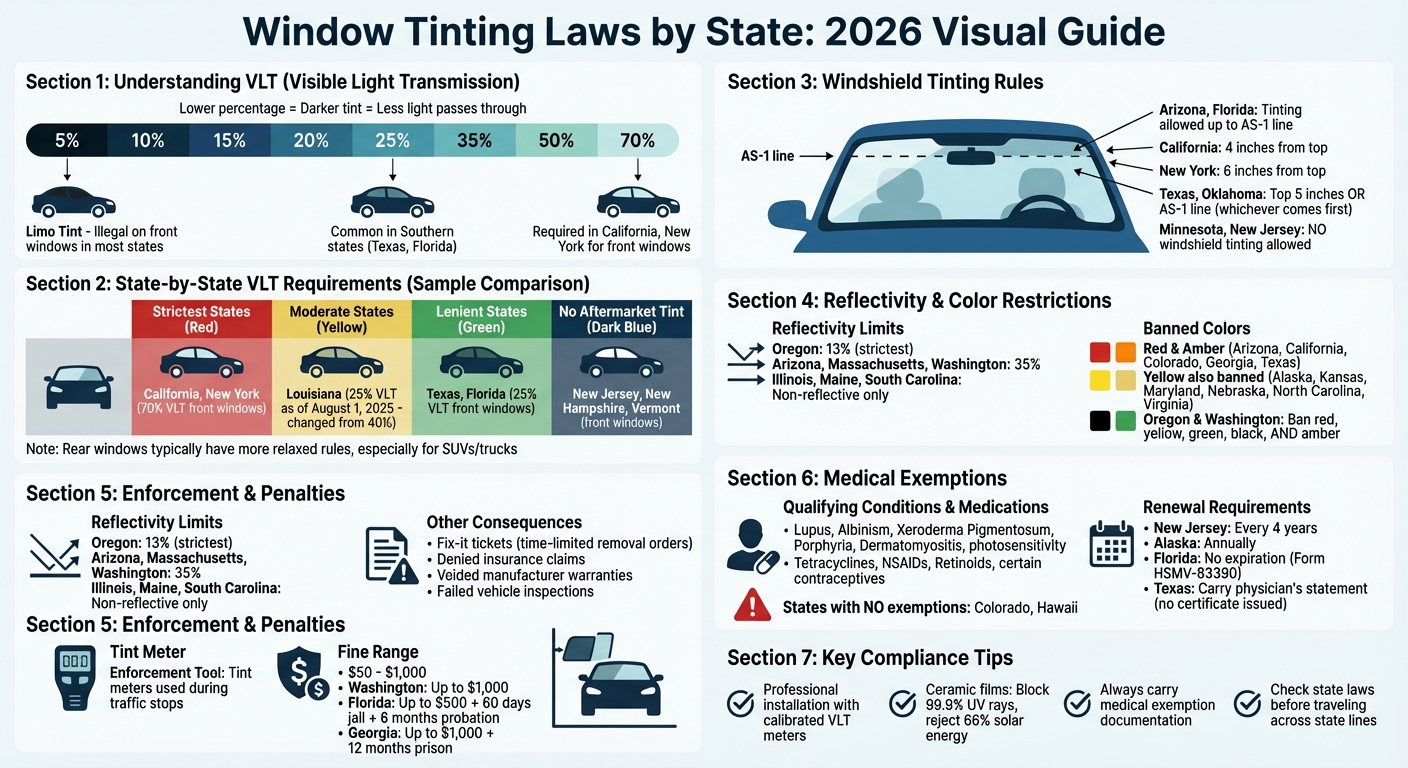
Visible Light Transmission (VLT): This measures how much light passes through your windows. States like Texas allow 25% VLT on front windows, while New York requires 70%.
Windshield Tinting: Most states allow a tinted strip on the top of the windshield, but rules differ on how far it can extend.
Medical Exemptions: Some states permit darker tints for medical reasons, but others, like Colorado, don’t allow any exemptions.
Enforcement: Police use tint meters to measure compliance, and penalties range from fines to repair orders.
Each state’s rules depend on factors like climate and safety priorities. This guide breaks down the 2026 tinting laws, helping you stay legal and avoid fines.
Window Tinting Laws by State: VLT Requirements and Penalties Comparison 2026
Stay Legal with 2024 Tint Laws in All 50 States
sbb-itb-74b4b25
Understanding Window Tinting Terms and Measurements
Before getting into the specifics of state laws, it’s important to know how tint darkness is measured. The key term here is Visible Light Transmission (VLT) – this refers to the percentage of visible light that can pass through your window glass and any tint film applied on it. A higher VLT percentage means more light gets through, resulting in a lighter tint. Conversely, a lower VLT percentage means the tint is darker. Regulations focus on the net VLT, which combines the effect of the factory glass and any aftermarket tint film. This means the effective VLT is typically lower than the rating listed for the film itself. To ensure compliance, professional installers use tint meters after installation. Some states, like Alabama, even allow a 3% margin of error during inspections. Let’s break down how these measurements translate into legal requirements across different states.
Visible Light Transmission (VLT) Explained
VLT percentages dictate the legal limits for each window, and these limits vary based on state laws and the position of the window. For instance, California and New York require a 70% VLT on front side windows, while Louisiana recently lowered its front window standard from 40% to 25%, effective August 1, 2025. Rear windows, especially on SUVs and vans classified as multi-purpose vehicles, often have more lenient rules. While darker tints like 5% – commonly called "limo tint" – might seem appealing, they’re illegal on front side windows in most states and can severely limit visibility at night. Next, we’ll explore the AS-1 line and its role in windshield tinting regulations.
The AS-1 Line on Your Windshield
The AS-1 line is a key reference point for windshield tinting. This line, marked by the manufacturer, is typically located 4 to 6 inches down from the top of the windshield, just above the rearview mirror. It defines the legal boundary for applying a non-reflective tint strip.
"The AS-1 line marks the legal starting point for window tinting at the top of the windshield… Many states let you tint the top part of your windshield but require the lower section to stay clear for driver visibility".
Some states, like Arizona and Florida, allow tinting up to the AS-1 line, while others, like California and New York, use fixed measurements (4 inches and 6 inches from the top, respectively). In Texas and Oklahoma, the rule is a combination: "top 5 inches or the AS-1 line, whichever comes first". Meanwhile, states like Minnesota and New Jersey prohibit any windshield tinting.
Reflectivity Limits and Banned Tint Colors
Tint regulations don’t just focus on darkness – they also address reflectivity and color to ensure safety and visibility. Reflectivity limits are designed to reduce glare from mirror-like surfaces. For example, Oregon enforces a strict 13% reflectivity limit, while Arizona, Massachusetts, and Washington allow up to 35%. Some states, including Illinois, Maine, and South Carolina, only permit non-reflective tints. Metalized films, which can exceed these reflectivity limits, are often restricted.
When it comes to color, regulations aim to prevent confusion with emergency vehicle lights and ensure clear visibility. Red and amber tints are widely banned in states like Arizona, California, Colorado, Georgia, and Texas. States like Alaska, Kansas, Maryland, Nebraska, North Carolina, and Virginia also prohibit yellow tints. Meanwhile, Oregon and Washington go further, banning red, yellow, green, black, and amber tints altogether. Always double-check your state’s rules before installing tint to avoid fines or repair orders.
Window Tinting Laws for All 50 States
Understanding window tinting laws is crucial since each state has its own set of rules. What’s perfectly fine in one state could get you a ticket in another.
Windshield Tinting Rules by State
In most states, you can add a non-reflective tint strip along the top of your windshield. This strip typically needs to stay above the manufacturer’s AS-1 line or within a specific range, usually 4 to 6 inches from the top edge. The AS-1 line, marked by the manufacturer, often serves as the legal boundary for tint application. However, some states completely ban windshield tinting to ensure clear driver visibility.
Front Side Window Tinting Rules by State
Front side windows face the strictest regulations since they directly affect driver visibility and law enforcement safety during traffic stops. States like California and New York require a minimum of 70% Visible Light Transmission (VLT), meaning the windows must let in at least 70% of light. Michigan, on the other hand, permits any tint darkness on the top 4 inches of front side windows. Starting August 1, 2025, Louisiana will lower its front side window VLT requirement from 40% to 25%. States in the South, such as Texas and Florida, often allow darker tints, with limits around 25% VLT. Meanwhile, New Jersey, New Hampshire, and Vermont completely ban aftermarket tinting on front side windows. These variations mean that a tint perfectly legal in one state could be a violation in another.
Rear Side and Rear Window Tinting Rules by State
Compared to front windows, rear side and rear windows generally have more relaxed rules, though they depend on whether your vehicle is classified as a passenger car or a multi-purpose vehicle like an SUV, van, or truck. For example, Alabama and Florida allow much darker tints on rear windows for SUVs and trucks, while sedans face stricter limits. In New York, sedans and coupes must maintain 70% VLT on rear side windows, but SUVs and vans can use darker tints. States such as Arizona, Florida, and Illinois require vehicles with tinted rear windows to have dual side-view mirrors to ensure proper rear visibility. To determine which rules apply to your vehicle, check its classification on the Federal ID label. These state-specific details lay the groundwork for understanding exemptions and how these laws are enforced.
Special Rules and Exemptions by State
Medical Exemptions for Darker Window Tint
Some states allow darker window tints for individuals with specific medical conditions, such as Lupus (SLE), Albinism, Xeroderma Pigmentosum (XP), Porphyria, Dermatomyositis, and other forms of photosensitivity. Certain medications, including Tetracyclines, NSAIDs, Retinoids, and some contraceptives, can also trigger severe UV sensitivity, qualifying drivers for these exemptions.
To apply, drivers typically need a signed statement from a licensed physician or optometrist, submitted along with a completed DMV or DOT form. Once approved, the exemption certificate must be kept in the vehicle at all times. In Texas, for instance, drivers are required to carry their physician’s statement instead of a separate exemption certificate, as the state no longer issues them. Additionally, many states now accommodate virtual consultations for obtaining medical tint exemptions.
However, not all states allow medical exemptions. For example, Colorado and Hawaii do not permit any exemptions for window tinting, regardless of the medical condition. The duration of exemptions also varies: New Jersey mandates renewal every four years, Alaska requires annual updates, while Florida offers exemptions with no expiration date using Form HSMV-83390. In California, medical exemptions are limited to clear UV-blocking films, and DMV approval is required.
How States Enforce Tinting Laws and Penalties
Law enforcement officers use handheld tint meters to check the visible light transmission (VLT) of windows during traffic stops. For example, in Aurora, Illinois, the adoption of tint meters led to 291 citations in just five months, compared to only two the prior year. Some states, like New York, have ramped up enforcement through random roadside checks and require mandatory tint testing during annual vehicle inspections.
Penalties for violating tint laws can range widely. Fines start at $50 and can climb to several hundred dollars depending on the state and the number of offenses. In Washington, fines can reach up to $1,000 for non-compliance. Florida enforces stricter consequences, including up to 60 days in jail, 6 months of probation, and a $500 fine. Georgia takes it a step further, with penalties of up to 12 months in prison and a $1,000 fine for illegal tinting.
Some states issue "fix-it" tickets, giving drivers a specific timeframe to remove or replace the illegal tint to avoid additional fines. Beyond fines, illegal tinting can lead to denied insurance claims in the event of an accident. Additionally, some car manufacturers may void warranties if the installed tint film does not comply with legal standards.
Conclusion
Understanding and following state window tinting laws can save you from fines, inspection failures, and potential legal trouble. These laws aim to balance the benefits of tinting – like UV protection and heat reduction – against the need for clear driver visibility and overall road safety. Violating regulations, such as using an incorrect VLT (Visible Light Transmission) or exceeding reflectivity limits, can lead to fix-it tickets and fines that may reach up to $1,000.
Key Points to Remember
Here are the essential takeaways for legal and hassle-free window tinting:
Know your state’s VLT requirements. The VLT percentage measures how much light passes through your windows. Some states might allow 35% VLT, while others require up to 70% VLT for front side windows to ensure good visibility.
Opt for professional installation. Experts use calibrated digital VLT meters and provide compliance stickers to ensure your tint meets legal standards from the start. High-quality ceramic films can block up to 99.9% of harmful UV rays and reject up to 66% of total solar energy – all without disrupting GPS or cell phone signals.
Carry your tint documentation. If you qualify for a medical exemption due to conditions like Lupus or Albinism, always have your physician’s statement or exemption certificate with you. Be aware that not all states allow medical exemptions, and renewal policies vary widely.
Illegal tint can have broader consequences. Beyond fines, non-compliant tinting could impact insurance claims or even void your vehicle warranty. Some insurers may deny claims if illegal tint contributed to an accident. Working with professionals who understand your state’s laws ensures you stay compliant, whether you’re driving locally or traveling across state lines.
FAQs
What are the consequences of having illegal window tint on your vehicle?
Penalties for illegal window tinting differ across states, but they often include fines, citations, and the requirement to remove or adjust the tint to meet legal standards. During routine traffic stops, law enforcement officers may issue tickets if the tint is too dark, excessively reflective, or features prohibited colors. The cost of fines can vary widely, ranging from small fees to more significant amounts, depending on the state and the severity of the violation.
Some states issue "fix-it tickets", which give vehicle owners a set amount of time to resolve the issue. Ignoring these tickets can result in additional penalties or even issues with renewing the vehicle’s registration. To steer clear of these hassles, it’s crucial to know your state’s tinting laws – especially for areas like front side windows and windshields, which often have stricter rules.
How can I qualify for a medical exemption for window tinting?
To get a medical exemption for window tinting, you’ll generally need proof of a medical condition that justifies using darker tint than your state’s standard regulations permit. This often involves obtaining a signed statement from a licensed physician or medical professional. Conditions like light sensitivity or other health issues that make regular tint limits impractical are commonly cited.
The next step usually requires submitting this documentation to your state’s Department of Motor Vehicles (DMV) or a similar agency. In some states, you may also need to carry proof of the exemption in your vehicle or renew it on a set schedule. Since the rules differ from state to state, it’s essential to review your local laws to ensure you’re following the correct procedures.
What are the rules about window tint reflectivity and color in the U.S.?
When it comes to window tint laws, rules about reflectivity and color can differ depending on the state, but there are some general standards to keep in mind. Most states set limits on how reflective a tint can be to minimize glare and avoid creating a mirror-like effect that might impair other drivers’ visibility. In many cases, the reflectivity limit is around 20%, though the exact percentage varies by location.
As for color, certain tints – like red, amber, or blue – are often prohibited because they can be distracting or cause confusion. Additionally, some states mandate that specific windows, such as the windshield, must have non-reflective tints. To steer clear of fines or the hassle of removing your tint, it’s a good idea to review your state’s regulations before installing any window film.
To schedule an appointment with your friendly neighborhood experts at Car Repair Services, give us a call at +1 718-470-2223 or fill out the form below with your information and requested services. One of our team members will get back to you as soon as possible to confirm your appointment.
mailing list to receive updates on new arrivals, offers and other discount information.
We use cookies to ensure that we give you the best experience on our website. If you continue to use this site we will assume that you are happy with it.Ok